
A Roma
A "realist" philosopher's exile from Harvard

Beauty from the vault: Raphael’s portrait of Castiglione from the Met exhibit:

Today is Tuesday, and therefore I will begin with some comments mainly on the language of this Sunday’s gospel reading:
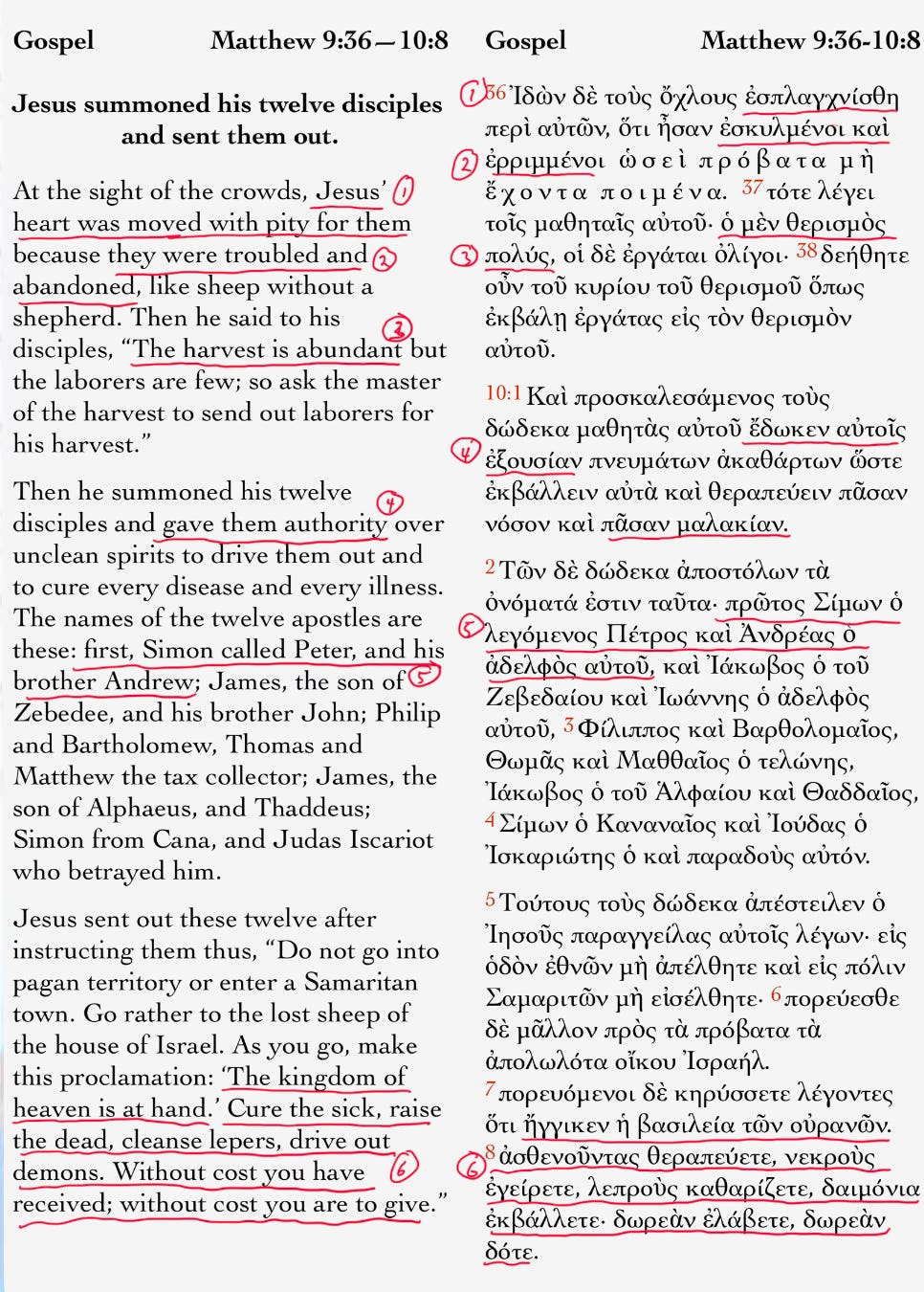
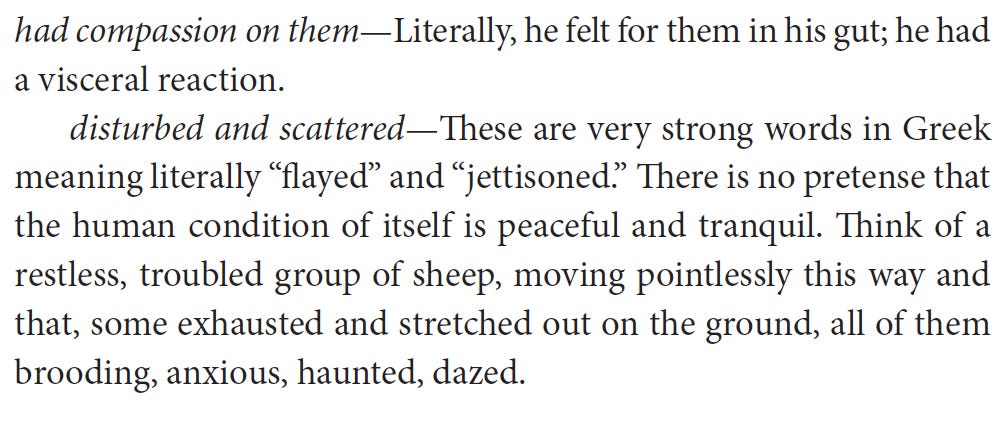
1—his “heart was moved with pity for them.” Here, I think the NAB does a better job than the language of “he had compassion on them” of most other translations. Because I have been working on the concept of a passion (in contrast with an emotion), I am more sensitive now to the proper language. What the Greek says is that he was moved in his gut. He suffered a passion in his gut. The gut was regarded as the seat of pity (“I beseech thee by the bowels of Christ”). The heart is not quite appropriate: this was the seat of anger, boldness, and endurance. But it is the part of the body we speak of in connection with pity, although we speak of “gut feeling,” “gut instinct,” and “visceral reaction.” Probably that last phrase is the best: “he reacted viscerally to what he saw.”
2—But so far this is a bodily reaction. Perhaps it could have been seen by his disciples. Perhaps he winced or moaned or showed sorrow on his face. But what he was moved by, he would have had to report to them. We can therefore be pretty sure that “because they were troubled and abandoned” (using unusual words in the Greek) represents Jesus’ own report to his disciples and Jesus’s own description of his passion. Here is how I handle these lines in my book, Be Good Bankers:
3— “The harvest is abundant.” Today, reading these words, for the first time I have been struck by the radical change of imagery. First the crowd following him are severely distressed sheep. Then they become a harvest. Usually, you harvest something which is strong, healthy, and fructified. This jarring change confirms that the text that we see is the composition of two things: (i) what Jesus said to them then was “The harvest is abundant;” (ii) what he explained (presumably to Matthew later) about his passion, “I felt pity then in my gut for the distress of the crowd that was following me.”
4— “He gave them authority … over every illness.” Two things here. First, they did not assume or cultivate or gather their authority. They received it from him by a deliberate act by which he conferred it upon them. This shows that the typical mode in which disciples have authority was by its being conferred. It may be conferred in non-standard ways (e.g. Saul’s being struck blind), but it must be conferred not seized. All claims of church governance must take this into account. One must ask: What is your warrant? On what basis do you claim authority over other Christians? Second, “every illness” is strictly “every softness” (malakia) or “every infirmity” or even “every vulnerability or weakness.” I like this last expression, because it clearly extends to psychological afflictions and moral conditions outside our control. Douay-Rheims has “all manner of infirmities.”
5— We know that in the lists Peter is always first and Judas last. One might say: Peter’s positive standing mirrors Judas’s negative standing. You cannot amplify the latter without committing yourself to amplifying the former. But here Peter’s primacy is made even more striking by the fact that, although he is named as one of two brothers, still, somewhat awkwardly in the Greek (it must be confessed) he is identified as “first.” It’s not the pair which is first, but he who is first. He’s not “first among equals” even in the pair. The pair cannot be mentioned without one’s flagging Peter’s special status.
6— The question arises: do the successors of the Apostles continue to enjoy these powers, as the original Apostles did? Protestants have traditionally held that miracles were needed to establish the church, and when that was accomplished, “the age of miracles” passed. Catholics have never believed this. Yet, there seems implicit in the language here a rule: raisings from the dead and exorcisms and healings are for the sake of indicating the nearness of the Kingdom and may be expected only insofar as they serve that role; also, resurrections and castings out and healing will continue to happen but “in the Kingdom,” that is, spiritually. Remember Our Lord’s own words: what is the greater miracle, to say “your sins are forgiven” or to say “rise up, take your pallet, and walk?”
Through some accidents my thoughts were turned yesterday to the case of John Wild, who quite unusually for a Harvard professor in 1961 left his tenured position, in the philosophy department, out of a kind of disgust or protest against the strongly analytic turn of the department then, which was understood as taking place upon the insistence of W.V. Quine. (One must remember that Whitehead was in the department then, and it was not too many years after Santayana was a professor there.) He went first to Northwestern and then to Yale, which he regarded as more hospitable to his project, which was to participate in the recovery of the “realist” philosophy (as he called it) of Plato and Aristotle, then being undertaken mainly by neo-Thomists such as Maritain and Gilson.
Today, I don’t have time except to draw this philosopher to your attention. I’ll try to post more about him later. I wrote to a friend yesterday:
In the Harvard philosophy dept library there was a copy of the two volumes of Joseph Gredt’s manual on Thomistic metaphysics, Elementa PhilosophiaeAristotelico-Thomisticae. The lore was that John Wild used these books for his seminar on metaphysics, on the grounds that the Thomistic tradition “really” took metaphysics seriously, and that if you wanted to study metaphysics you should go to those who believe it is a science.
One wants a neutral word for Leo Strauss’s review of Wild’s book on Plato. Could it be described as “dismissive,” “contemptuous,” or simply “highly critical”? That book itself may be consulted here.