
After Passion: Part I
The abolition of man

Over the next three days, I will post the talk which I gave at UATX on Tuesday, entitled, “A Plea for a Passionate Moral Psychology,” which could just as well have been called, “After Passion.”
—> I loved my visit. It is a remarkable place doing all kinds of things well. I had many great talks with students. The professors are dedicated, clever, and knowledgeable. <—
In this first part, I document that our common self-understanding did shift from passions to emotions, I show that the shift is important, and I point out how C.S. Lewis gets misled in lecture one of The Abolition of Man because of the shift.
But first, beauty from the vault, the stained glass window of St. Luke in St. Mary’s Cathedral, Austin. I collect images of St. Luke now, and his “living creature,” the ox.

In this talk I plan to do three things. First, I will document the massive shift in our common self-understanding, which has come from our once talking about ‘passions,’ to our now talking solely about ‘emotions.’ Second, I will say a little to convey the older understanding of the passions and therefore to suggest what we lost when we gave that up. Third, I will speculate briefly as to how and why this massive shift took place.
So then, first I document that this massive shift has taken place, and I begin in this way.
We speak of venting our emotions, expressing our emotions, and being true to our emotions. Psychology departments study ‘emotional development.’ Religious people may be heard complaining that worship services, or songs, are “too emotional” or “lacking in emotion.” Children must learn to “regulate” their emotions, while it is thought wrong to “suppress” our emotions altogether. Emotions are believed to distort judgment—although they are sometimes thought necessary for strengthening judgment.
We speak in all of these ways and more, and yet, intuitively, we have little clarity about what an emotion is, how many there are, and how they should be classified. Where exactly does an emotion exist? How can I tell one from another? Do any two of us walk around with the same list of emotions?
In English, talk of emotions is only about two hundred years old. Before then, for millennia, people spoke of the passions— passiones, in Latin--or sometimes the “affections.” The word “sentiment” seems to be a relatively late contrivance, closer to “judgment” than to “affection.”
Shakespeare for instance refers to passions, affections, humours, tempers, and moods, but he never refers to emotions. He knew neither the word nor the concept.
When the King James Bible speaks of “the passions” in general, it does so on the assumption that the passions show our place in the universe as human beings, as neither angels nor brutes. For example, when the people of Lystra intend to worship Paul and Barnabas as gods, because of the marvels they had worked, these Apostles object, “Why do ye these things? We also are men of like passions (ἄνθρωποι ὁμοιοπαθεῖς) with you,” (Acts 14:15)
They are assuming that only corporeal beings can be subject to passions. Spiritual beings cannot be worked upon by material agents.
Modern translators who know only the emotions do not know what to do with this verse. It wouldn’t establish someone’s humanity to say, “We feel the same emotions as you feel.” The New International Version gives “We too are only human, like you.” The English Standard Version has “We also are men, of like nature with you,” which is a blatant mistranslation, because the Greek, homoiopatheis, does not mean “of like nature.”
So here the conception of a human being as being set apart from pure intelligences like angels, in being subject to passions, has been completely lost. What the text is saying cannot even be comprehended by the translators!
A Google ngram supports what one might have sensed from scholarship and wide reading. One can see that the word which was favored until the mid-19th century has now been supplanted by a different word. After the frequency of ‘passions’ diminishes to nothing, the frequency of ‘emotions’ arises from nothing:
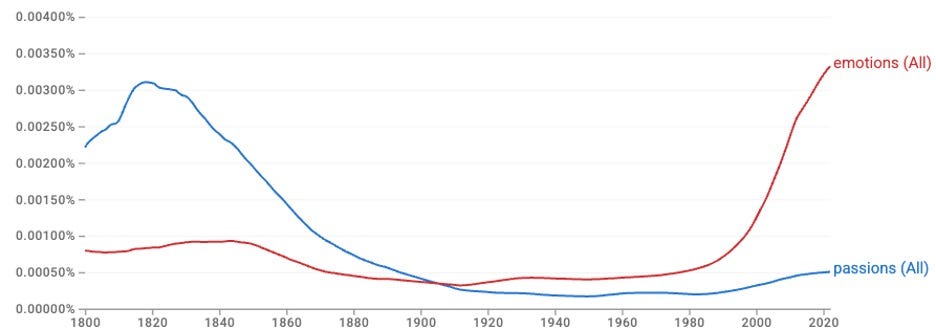
The word, ‘sentiments,’ was apparently a transitional term. Hume wrote a Dissertation on the Passions; Smith followed with his Theory of the Moral Sentiments. “Sentiments” outlasted “passions,” because it became a favorite term of literary critics.
As a side point, one should note the general decline, at the turn of the last century, in the usage of all words directed at feeling and interiority. My friend and colleague at George Mason University, Dan Klein, the Adam Smith scholar, pointed out this phenomenon to me:
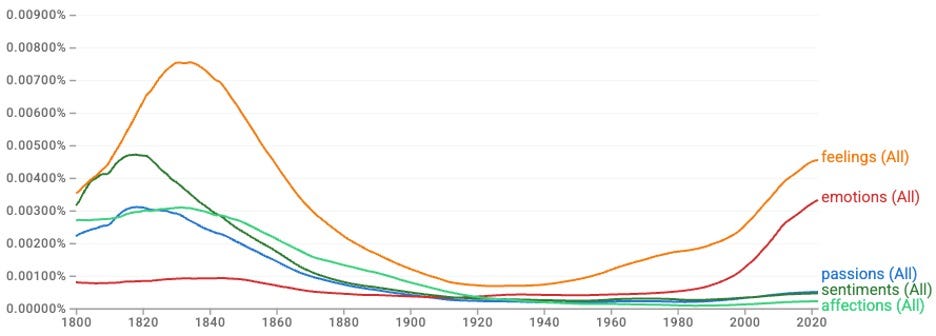
From the ngram one sees that talk of “feelings” and “emotions,” as much as “passions,” “sentiments” and “affections,” went out of favor for about hundred years and has recently resurged. The depression corresponds to the two great wars, and the nadir coincides with the publication in 1925 of John B. Watson’s book, Behaviorism.
Thomas Dixon, an intellectual historian at Cambridge University, has written a book to document the change I am drawing attention to, entitled, From Passions to Emotions: The Creation of a Secular Psychological Category (Cambridge University Press, 2003). “Emotions are everywhere today,” his book begins, “It is surprising, then, to discover that the emotions did not exist until just under two hundred years ago” (p. 1). Dixon accepts the Whorfian hypothesis that to lack a word for a thing is to lack the very concept for the thing.
Since he is an intellectual historian, he is interested mainly in how intellectuals speak, especially moral philosophers, and pastors who were influenced by them. For Dixon, the watershed figure in the academy is Thomas Brown, holder of the chair of Moral Philosophy in the University of Edinburgh, from 1810 until his death in 1820. Brown’s posthumous Lectures on the Philosophy of the Human Mind, Dixon says, is the first systematic work in which the term “emotions” is used for all those “feelings” which were neither sensations nor intellectual states. Here is the passage where Brown explains what these new entities, the emotions, are:
“The exact meaning of the term emotion, it is difficult to state in any form of words, — for the same reason which makes it difficult, or rather impossible, to explain, what we mean by the term thought, or the terms sweetness or bitterness. …
Emotions are undefinable apparently, and must be introduced by ostension:
Every person understands what is meant by an emotion, at least as well as he understands what is meant by any intellectual power; or, if he do not, it can be explained to him only, by stating the number of feelings to which we give the name, or the circumstances which induce them. All of them, indeed, agree in this respect, that they imply peculiar vividness of feeling, with this important circumstance, to distinguish them from the vivid pleasures and pains of sense, — that they do not arise immediately from the presence of external objects, but subsequently to the primary feelings, which we term sensations or perceptions. Perhaps, if any definition of them be possible, they may be defined to be vivid feelings, arising immediately from the consideration of objects, perceived, or remembered, or imagined, or from other prior emotions. (164)[1]
Take a particularly gripping pleasure or pain of touch or taste (as presumably only these senses modalities generate sensations of sufficient vividness), and now add that such a feeling is not immediately caused by the perception of anything without, and, according to Brown, this is the best we can say about what an emotion is.
In any case, Brown’s definition suits well the etymology of the term ‘emotion.’ ‘Passion’ comes from the Latin, passio, and has an obvious correlate, actio, as well as an obvious Greek equivalent, pathos. It also has an obvious intuitive meaning, of being affected by being acted upon by something from without. No one who had had a classical education could use the word ‘passion’ without being aware of the word’s reverberations in Demosthenes, Plato, and Cicero, and in the disputes between the Stoics and Peripatetics. The central religious use of the word, as in “the passion of the Christ”—which means the suffering of both bodily and spiritual assaults from without—would support these intuitions and reverberations. In contrast, the word ‘emotion’ comes from the French verb emouvir, and it means something very different, namely, to be subject to an agency from within.
To be subject to a passio is to be affected by an agent acting from without. To be e-moved, is to be stirred up and agitated from within, like slime being stirred up from the bottom of a murky pond by an agency we know not what.
So, that there has been a shift from talk of passions to talk of emotions is clear. But why is it a ‘massive’ shift, as I have asserted? Why is it an important shift?
C.S. Lewis is struggling with the shift in the first lecture of The Abolition of Man. If you know the book, you will remember that the first lecture is entitled, “Men Without Chests.” Lewis devotes the first half of that lecture to criticizing the philosophy of the authors of an English composition book, which he calls “The Green Book.” These authors aim to deflate talk of emotions, because emotions, they believe, come from within and have no objective standing. For instance, if I stand in front of a great waterfall, and I form the sentiment that it is sublime, these authors contend that what I really mean is that I have feelings within me, feelings of sublimity, which I mistakenly project onto the waterfall.
Lewis replies sharply:
the man who says This is sublime cannot mean I have sublime feelings. Even if it were granted that such qualities as sublimity were simply and solely projected into things from our own emotions, yet the emotions which prompt the projection are the correlatives, and therefore almost the opposites, of the qualities projected. The feelings which make a man call an object sublime are not sublime feelings but feelings of veneration. If This is sublime is to be reduced at all to a statement about the speaker’s feelings, the proper translation would be, I have humble feelings.
It’s curious that Lewis is prepared to say that veneration has a specific feeling, and that feelings can be humble. Is veneration, then, an emotion? Is humility an emotion? How can we say? Also, Lewis’s language that a correlative is “almost the opposite” is strange, given his classical education, since correlatives are one of four classical species of opposition, along with contraries, contradictories, and privatives. Why say it is “almost” so?
Be that as it may, Lewis then moves on to his main point, which is that an order of “objective value” exists, which he calls “The Tao,” and our “emotional states” should “conform” to it:
[The Tao] is the doctrine of objective value, the belief that certain attitudes are really true, and others really false, to the kind of thing the universe is and the kind of things we are. Those who know the Tao can hold that to call children delightful or old men venerable is not simply to record a psychological fact about our own parental or filial emotions at the moment, but to recognize a quality which demands a certain response from us whether we make it or not. I myself do not enjoy the society of small children: because I speak from within the Tao I recognize this as a defect in myself — just as a man may have to recognize that he is tone deaf or colour blind. And because our approvals and disapprovals are thus recognitions of objective value or responses to an objective order, therefore emotional states can be in harmony with reason (when we feel liking for what ought to be approved) or out of harmony with reason (when we perceive that liking is due but cannot feel it). No emotion is, in itself, a judgement; in that sense all emotions and sentiments are alogical. But they can be reasonable or unreasonable as they conform to Reason or fail to conform.
I want you to notice two things about these remarks. First, Lewis sets up the problem as that of whether “objective value” exists. Those who recognize the Tao recognize objective value and preserve human nature, while those who are ‘outside’ the Tao fail to recognize objective value and are on the road to abolishing human nature. And yet what he is talking about is not the objectivity of value but whether we respond to value. To call children delightful is “to recognize a quality which demands a certain response from us.” It’s not that the quality is objective, that is, that it exists in other things, but rather that it “demands a certain response from us,” that is, our responses to this quality, our being affected by it, may be apt or not. Lewis’s problem, really, is not that of “objective value,” but rather whether what he calls “emotions” may not, after all, be responses to something without. He misdescribes his own problem.
The second thing I want you to notice is how he slips in the word “sentiment.” Lewis is a careful writer. He does this deliberately:
No emotion is, in itself, a judgement; in that sense all emotions and sentiments are alogical. But they can be reasonable or unreasonable as they conform to Reason or fail to conform.
Why didn’t he simply write, “in that sense all emotions are alogical”? The reason is that, as a careful inspection of the chapter shows, Lewis’s tendency, as a literary critic and a man of highly refined taste, is to reserve the word “emotion” for something welling up from within, like the “emotions” which the authors of the Green Book wish to deflate, and to use the word “sentiment” solely for responses to what is in the world.
The point may be put in this way. Lewis writes his book assuming that there are such things as emotions, and he thinks that his task is to persuade his reader, not to debunk the emotions, but to train them, so that they are responsive to objective value: “The head rules the belly through the chest — the seat, as Alanus tells us, of Magnanimity, of emotions organized by trained habit into stable sentiments.” But emotions, in fact, are not the sort of thing that can be trained. Lewis senses this, which is why he prefers to speak of sentiments not emotions. Emotions as agitations which well up within us, and which are potentially destructive, and are apparently separate from administrative and economic rationality, do indeed look like things that need to be handled, conditioned, and, in the ruling classes, debunked.
‘The Abolition of Man’ which Lewis warns against is not something looming in the future, that is, if we continue to neglect objective value. It is something which happened already in the past for him, over 100 years prior to when Lewis gave his lectures. To have abolished the passions, in order to replace them with emotions, was already the abolition of man. When the passions were abolished then of course there were no longer any “men of like passions” as the men of old.
We can begin to understand, then, why talk about this aspect of our nature declined once the passions were put aside in favor of emotions. Mere emotions must be mischievous. They can only interfere with the serious work of carrying on business, or serving in government or the military, and with one’s domestic duties. You would be doing a favor to someone, to debunk his emotions. A schoolboy could not become a mature man if his emotions had not been debunked. The authors of the Green Book were acting with great responsibility. They were fully correct in how they dealt with mere emotions. Properly to refute these authors, it is not enough to insist upon the existence of the Tao. One must likewise insist on the moral psychology of the passions.
[1] Volume 1, Hallowell: Glazier, Masters & Smith, 1836.
Providentially timely. This distinction is crucial for me as I begin a study of emotions -- yet, this corrective precisely highlights where my own hang-ups have been as I set out. Thank you.