
Back on Track
Across trackless countryside

Once when I played the Villanelle for horn by Paul Dukas at an audition, the judges asked me afterwards, “And you know how to pronounce that name, right?” I said with proper pride that I did, “Paul Du-kah.”
Ah, not so fast. See below.

(The Sorcerers’ Apprentice, by Paul Dukas.)
So I am going to review J.D. Vance’s book, Communion, for my next essay in The Catholic Thing.
(Before I proceed, look at that last sentence. It begins with “So.” Have you noticed how almost everyone, for almost every sentence they speak, begins with “So”? “So” has become like first gear in a manual shift car. People cannot get up to full speed speaking a sentence unless they start moving with a meaningless word. Sometimes I challenge my students in class: “For this class, we will practice the rule of not beginning sentences with ‘so,’ just to see if we can do it.” And it proves just about impossible for them, and it’s not easy for me also. Students start laughing at themselves, because it ought to be something you can easily avoid. I will often say, “And let’s at the same time observe the rule that we will not say ‘like’ as a filler.” I’ll add, “It’s not that it’s bad or evil or a sin to use these words, or that we are better people because of how we speak. Often, one wants to use them, so as not to appear affected, or deliberately to sound relaxed in speech and informal. —Or if one wants to imitate the Evangelist, Mark, whose every sentence, just about, begins with the Greek equivalent, kai. We can be confident that Peter began every sentence with “So.”—It’s rather that it ought to be in our power, if we choose, to speak without these words.” I’ll add that we can easily imagine speaking in important venues, or at important occasions for work, in which we certainly would wish to avoid them.)
(By the way, at least the automatic editor for Substack is showing that initial “so” in blue underlining. But it is not indicating it is a mistake. It is supposing that “so” at the start of a sentence is an inferential word and therefore needs to be offset with a comma. About auto correction—this same editor was telling me the other day that the phrase “was graduated from the university” was not proper English.)
But back to Communion. Antecedently, I’m scratching my head that someone just forty years old has written two memoirs. Can we expect a third in a couple of years, “My Years with Trump,” if he’s not elected to public office again? And then, God willing, many sequels afterwards? What does it say about you that you publish a book about yourself for every span of your life? Is it enough to say: “It sells”?
But I suspect my approach will be, for this venue, whether the book is likely to lead anyone to want to be Catholic. (Can a conversion story do anything more?) Currently, I don’t care much about the book as a justification for his politics, and I don’t have high hopes for it in advance, viewed in that way—although it’s a curious question. As a politician, he is a servant of Trump, “the king’s good servant and God’s first,” I suppose. But how is it that, in a republic not a kingdom, one serves a deeply flawed man and politician with a show of unswerving loyalty? It can’t be that in a republic a public servant (a ‘public servant,’ mind you) automatically serves the republic through service to a man. That project must inevitably look self-serving, indeed.
That’s been the main criticism of the book, right?, that it’s an exercise in self-promotion and opportunism.
In any case, as I look at it now, I think: the book is about Catholicism; therefore, it needs primarily to be evaluated for its effect on souls.
Another book I need to review is Immortal Souls by Ed Feser. Yikes, it’s a brick. I don’t know how I keep misplacing it, as I do, when it’s 500 pages thick and has a Christmas decoration green cover.
When I see a book like that I think to myself that, sure, the topic deserves 500 pages or more, but our age has no appetite for studying a 500 page treatise, and a book like that is highly unlikely to attain its purpose of drawing others to a correct view of human nature.
In this connection, I think of three things. I think of Walker Percy, who was deeply concerned—almost in a panic—about telling us how we were getting ourselves wrong, but early in his life he gave up essays for writing novels. The essays wouldn’t get through, he thought.
I think also of C.S. Lewis’s Abolition of Man. My wife often brings that book to my attention: you need to write something like that. It’s short, brilliant, truthful, and has been widely loved and studied. Wittgenstein was wrong that three words suffice to say everything important, but three beautiful essays possibly do suffice.
I think also of what Cormac McCarthy said when he was interviewed about The Road. He said no one today will read anything more than 200 pages long.
I don’t know why I agree to write book reviews. My last word on this for now would be that because I have a highly critical intellectual personality, on top of it all, the book reviews I’ve written in the past have not gained me a lot of friends.
But a loose end is that I promised to say something about the Gospel reading for this coming Sunday.
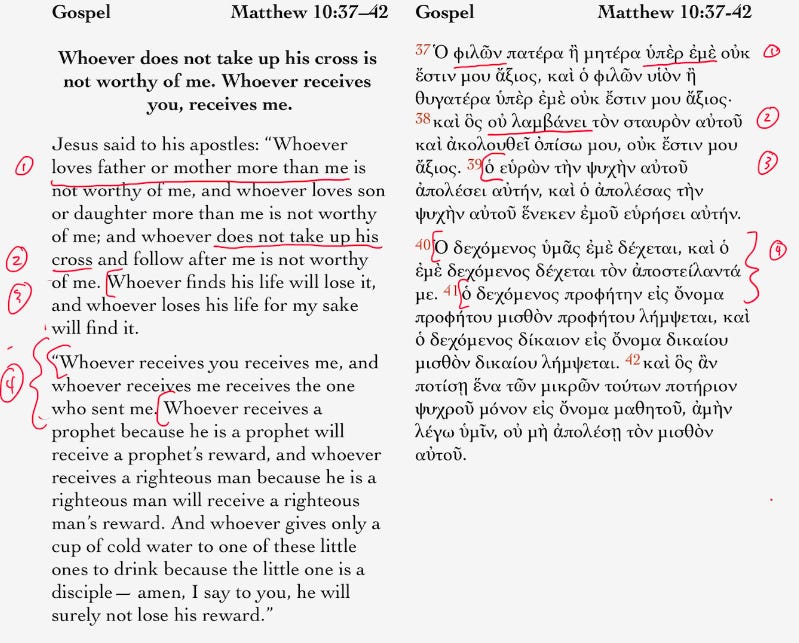
1—The way the NAB translates this language, which is very natural and an obvious first way to translate it, misleads the reader as to what the Greek says. The reason is that “loves more than” in English suggests a greater degree of affection. But in Greek (and indeed in sensible thought generally) to “love X more than Y” means to prefer X over Y and therefore to choose X rather than Y in cases of conflict. This is why the Greek uses the preposition uper to express the thought. There are other ways available to express comparisons of degree. And when you view Jesus’s language in this way, you see how marvelously complex it is and compact too, in saying so much with so few words. Father and mother? They receive their authority from God, right? A higher authority must always be followed in cases of conflict with a lower authority. That’s Our Lord’s thought there. Not “have more affection for.” Son or daughter? We have a fiduciary relationship to them. They belong to God and are merely entrusted to our care. So, the conflict meant here is when there is a disparity between my judgment as to how a child should be treated and God’s judgment, or a disparity between my son or daughter’s judgment about how he or she should be treated, and God’s judgment.
And people say that Jesus never asserts that he is God.
2—”take up his cross”: As far as I know, there is not a single reputable translation of this verse into English which does not use this language. And yet the Greek can just as much be rendered “accept” or “receive” his cross. And the commentators when they gloss the language say that this is what is meant, the willing acceptance of what comes to a Christian as his lot under God’s providence. But wouldn’t we be more helped, and isn’t it more accurate, if we said “accepts his cross”?
Logically, this teaching falls in the sequence of order of love. We ought to prefer God over parents. We ought to prefer God over children. We ought to prefer God over self. This last, to a classical mind, is the most extreme claim, because it was obvious that there was no other person whom one should love more than oneself.
3—But then we have the initial paradoxical claim that although it looks as though you are preferring God to yourself when you willingly see that you are destroyed for the sake of God, this is the only path forward for you actually to succeed in attaining your own good.
4—You can’t see it in English, but in the marked sentences Matthew gives Jesus’s language with what is called asyndeton. In Greek, one typically stitches each sentence to the one that came before with a “connecting particle” or “inferential particle.” In the marked sentences, there are no such particles. They are meant to be jarring. They are meant to shock syntactically as much as semantically.
Under the heading, “refinement in speaking French,” I’ve been corrected by a native speaker that, for the names Leon Walras and Georges Bernanos, the final “s” is pronounced.
But what about the composer, Paul Dukas? By ordinary rules of pronunciation, the “s” is silent. However, Dukas asked that it be pronounced; such was his preference. And that is why it should be sounded.
Ciao!
Your remark that 'when you view Jesus’s language in this way, you see how marvelously complex it is and compact too' makes me pause and wonder about the difference in manner of Jesus' speech in Matthew and in John. Much could be said about this, from various perspectives, I suspect.