
Brownson Capstone
Stanley leaves New Britain

In this post:
American manufacturing
examining Orestes Brownson
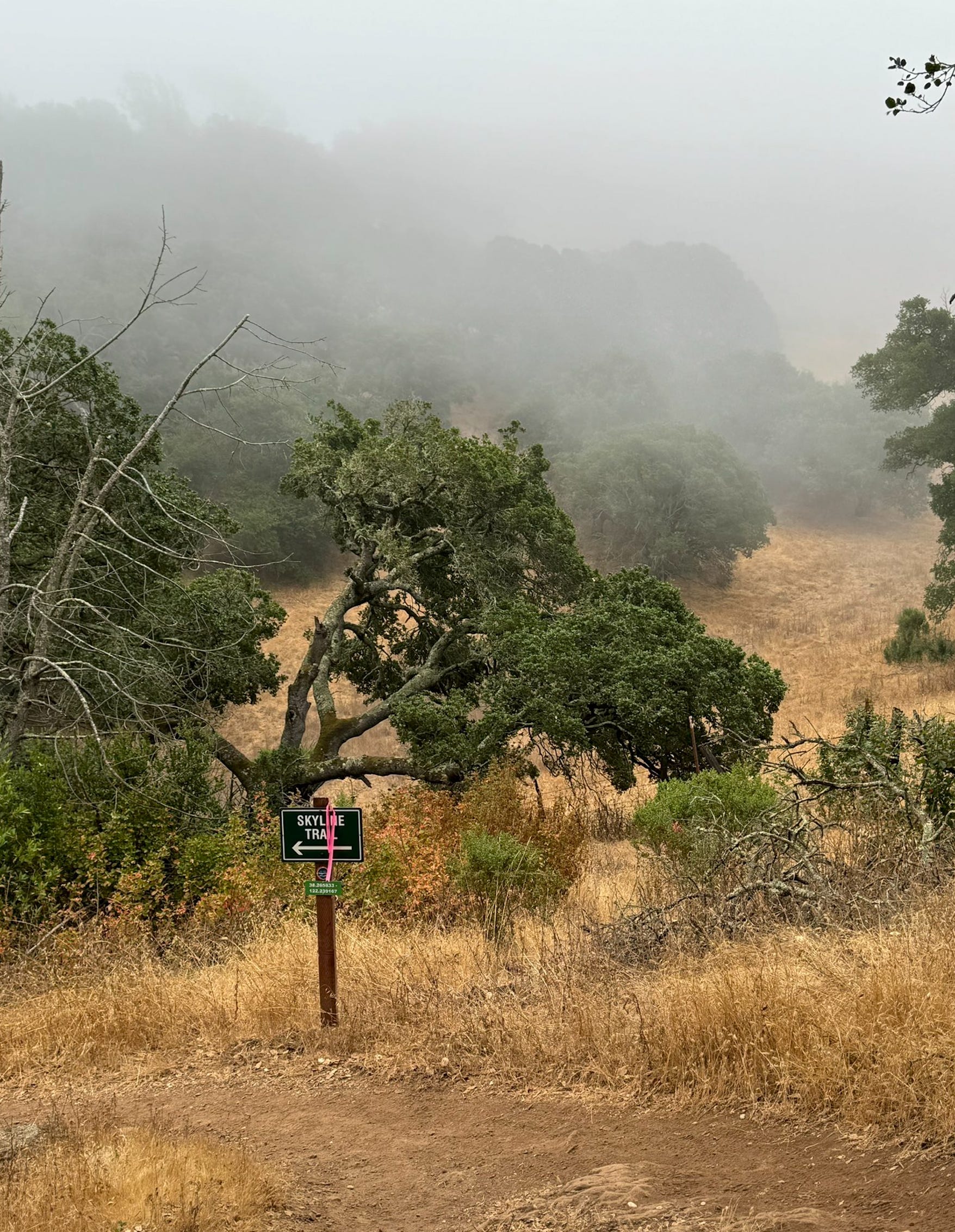
But first, beauty from the vault, from a hike in Napa Valley on a misty early afternoon:
(1) The problems of American manufacturing
I used to buy Stanley tools because they were made in America. The WSJ had a story yesterday about how the last Stanley factory in its storied location in New Britain, Connecticut, will close soon, because it makes single-sided tape measures only, whereas everyone wants double-sided. At least this is the explanation that management gives. Why if true they could not retool for double-sided was not explained. Some Stanley workers were quoted in the Journal saying that it’s not true that demand is now principally for double-sided.
An electrician came to my house yesterday to give an estimate for some work. He was using a Stanley double-sided tape measure, made abroad. I asked him whether he preferred double-sided. He said exactly the same thing that an electrician in the Journal story said, that single-sided suffices for 90% of his work, but 10% of the time double-sided is extremely convenient.
So, at least that claim about demand seems true. I don’t know about the expense of retooling and whether it could be at all justified.
The Journal also had a story about how Harley-Davidson is shifting to less expensive motorcyles, which have smaller margins but which they think can be sold in greater volume. One interesting detail: their famous plant in York, PA, could not make these less expensive models unless it had an exemption (which it had negotiated) from tariffs. It must use parts not subject to tariffs for the plan to work.
(2) examining Orestes Brownson
When Fr. McTeigue asked me yesterday in a discussion for his show, The Catholic Current, how AI has affected classroom teaching, I said that it made the term paper useless. But I said there were alternative ways to test the same skill, such as asking students to prepare essays in advance of an exam, in which they would simply come to the class and write out their work into a blue book. Such is the character of the exam in my capstone class in Political Economy this semester, on the thought of Orestes Brownson. Here is the exam, FYI. The students have had these questions for three weeks.
I’m not making the mistake of junior professors, of boasting about the quality and coverage of a course, by showing the difficulty of the exam. The questions set for an exam are not the same as the answers which are given! Rather, my point is to show how rich a course on Brownson can be.
—
Final Examination Brownson’s American Republic and The Convert
Choose one question from each group and write on three questions in total.
Group A: Brownson in Contemporary and Comparative Perspective
1. Critically assess, from the viewpoint of Orestes Brownson, the thesis of Patrick Deneen in his book Why Liberalism Failed. What would Brownson say is right about it, what wrong, what off the mark? In particular, consider how Brownson’s providentialist account of America’s founding differs from Deneen’s more straightforwardly historicist one, since that may be where the deepest difference lies. What alternative diagnosis might Brownson give of our contemporary problems?
2. Assess Brownson’s criticism of social contract theory. Is he correct that social contract theory remains the dominant theory of government in the United States even today? Detail his objections against it. Does contemporary liberal political philosophy — as found, for example, in Rawls— count as “social contract theory” in Brownson’s sense? Are his objections decisive?
3. When the European Union was formed, there was a controversy as to whether Europe would recognize its debt to Christianity in the preamble to its constitution. It did not, on the grounds that doing so would violate the “laical” character which government is supposed to have. Give a Brownsonian assessment of this controversy. Is Christianity the basis for any “organic constitution” of Europe? Could sovereign nations ever form a real union? Consider also whether the United States itself has, in Brownson’s terms, an “organic” Christian constitution or merely a providential one. Discuss these and other pertinent questions as they occur to you.
4. “Brownson is the most important political thinker for understanding America’s vocation in our time.” Argue for or against, giving reasons.
5. Brownson claims that the United States has a unique providential mission among nations. Assess this claim critically. Is it a form of American exceptionalism. How does it differ from the secular exceptionalism of, say, Lincoln’s “last best hope” or Woodrow Wilson’s progressivism? Is the claim still coherent after the experience of the twentieth century?
Group B: Exposition and Analysis of Brownson’s Key Arguments
6. State the main claims of The American Republic. Give an outline of the most important and most interesting views in the work. Your task in this question is not to give a critical analysis but simply to state the most important ideas in the book — and then indicate which of these ideas you find most surprising or most defensible, and why.
7. Give a menu of the different positions that Brownson held, in rough chronological order, before he became a Catholic. Say who the major thinkers were whom he followed. What are the constant threads, and what were the changes? What role does his essay on the Laboring Classes play in his journey? Finally, assess whether his pre-Catholic positions were ultimately abandoned in his mature thought or rather taken up and transformed — as Brownson himself believed. Is that claim convincing?
8. Brownson argues that the American nation is neither a consolidated national government nor a mere compact of sovereign states, but a union of states as political societies territorially constituted. Explain this view carefully. Does it resolve the antebellum dispute over secession? Does it have any bearing on contemporary debates about federalism, nullification, or the administrative state?
9. Brownson distinguishes between a nation’s providential constitution — given by God through history and circumstance — and its written constitution, which is a human artifact. Explain this distinction and its implications. Does it make Brownson a conservative? A progressive? Neither? What does it imply about the authority of the Supreme Court as interpreter of the written constitution?
Group C: Brownson’s Philosophical and Theological Foundations
10. Brownson wrote The American Republic before Rerum Novarum (1891) and the tradition of modern Catholic Social Teaching that followed. To what extent does his political thought anticipate, complement, or diverge from that tradition? Does his account of the relationship between state and Church cohere with the teaching of Dignitatis Humanae (1965)?
11. Must the nation as a whole follow a path of thought and conversion similar to Brownson’s own, as told in The Convert, if it is to embrace his understanding of the vocation of America? What is that path, in a nutshell?
12. Many critics of Brownson, then and now, charge that his mature political thought is insufficiently attentive to individual liberty and too quick to subordinate the person to the community, the state, or the Church. Is this criticism fair? How does Brownson understand the relationship between liberty and authority, and is his account ultimately satisfying? Discuss in relation to Constant’s distinction of the liberty of the ancients from the liberty of the moderns.
Ciao!
Excellent questions on Brownson- would love to see some of the answers, and reflections on the course.