We discussed the wines of course, gathered around the Easter dinner table—we five couples and four grown children—and the Amarone was the clear favorite, over the elegant North Coast Pinot, and over the “crowd pleaser” too, which held up surprisingly well in such company, Orin Swift’s red blend, Abstract.
But we also discussed the Easter and the Triduum which we had just celebrated. And we took up four questions, which I shall recount.
First, we wondered whether it was true, as our pastor had claimed, that, when Jesus said the first line of Psalm 22 from the cross, “My God, my God, why have you forsaken me?”, he was using the first line of a psalm to refer to the whole psalm (as was conventional), and that, because that psalms turns at the end to a claim of victory, he was not, in saying that line, merely expressing desolation, but also claiming ultimate victory over sin and death?
For the record, Psalm 22 at around verse 22 does not express abandonment at all:
he has not despised or abhorred the affliction of the afflicted; and he has not hid his face from him, but has heard, when he cried to him.
From thee comes my praise in the great congregation; my vows I will pay before those who fear him.
Someone said in reply to this idea that he had checked the Catena Aurea, and apparently no Father gave a similar interpretation. Rather, the Fathers make a distinction along the lines, “as man, he was abandoned, but as God, he was not abandoned.”
It seems right to say that even if Jesus was referring to the whole psalm, still, the first line of it presents a difficulty: how can God be abandoned by God? St. Thomas in his commentary on Matthew engages with this difficulty to exclude both an Arian and a Nestorian interpretation of it. But his reference to Isaiah (in bold) shows that he sees that the whole of Psalm 22 is in play:
It must be said that from the very manner of speaking it is evident that this verse ought to be understood of Christ: for it is said of him in the last chapter of John (20:17), I ascend to my Father and your Father, to my God and your God. He calls him Father insofar as he himself is God; he calls him God insofar as he himself is man. Therefore, when he says My God, my God, it is manifest that he speaks according to his human nature; and he repeats the words in order to express the greatness of his human affection. As for the words thou hast forsaken me, they are spoken by way of similitude: for whatever we possess, we possess from God; hence just as when someone is exposed to some evil, he is said to be forsaken, so when the Lord permits a man to fall into the evil of punishment or of fault, that man is said to be forsaken. Christ therefore is said to be forsaken not with respect to the union of the two natures, nor with respect to grace, but with respect to the Passion; as it says in Isaiah 54:7, For a small moment I have forsaken thee.And he says why? — not as though from weariness, but this can express compassion toward the Jews; and he did not speak these words until after the darkness had come over the land. He wishes to say, as it were: why hast thou willed that I should be handed over to suffering, and that these people should be plunged into darkness? The words also signify wonder, for the charity of God is indeed a thing of wonder. As Romans 5:8 says: God commendeth his charity towards us, because when as yet we were sinners, according to the time, Christ died for us.
Second, we discussed another claim of our pastor, that the saying from the gospel of John, “for they did not yet understand that it was necessary for him to be raised from the dead,” applies to all Christians in virtue of their baptism. We granted that it was true and obvious to us now that Christ, in virtue of his divinity, and his mission to redeem the world, could not possibly have been “held” in the grave. But did the same necessity now extend to any Christian who had been sacramentally (interiorly, truly, really) identified with Christ—so that we should live our lives with the confidence that death cannot possibly hold us bound in the grave? Someone said that such a conviction was surely the reason why Christians have historically insisted in being buried as if asleep in cemeteries, even against local custom, while the weakening of this conviction was the reason why cremation was becoming more common among Christians.
Third, I raised a difficulty about the Exsultet, the great sung prayer at the beginning of the Vigil Mass.
I said that if all the things claimed in the Exsultet about keeping the Easter Vigil are true, then it is puzzling that our bishops and priests do not more strongly urge the faithful to attend the Vigil Mass in particular, over the other Masses of Easter. Rather, they present the Vigil Mass as one among equal alternatives. (Catholics in general have a hard time with the idea that, among several permissible alternatives, one is to be preferred.)
I raised this question because this year I was deeply impressed by the holiness of simply being at the Vigil Mass apart from anything accomplished or received in the course of the Mass.
For the record, here are some lines from the Exsultet:
This is the night that even now, throughout the world, sets Christian believers apart from worldly vices and from the gloom of sin, leading them to grace and joining them to his holy ones.
This is the night, when Christ broke the prison-bars of death and rose victorious from the underworld.
Our birth would have been no gain, had we not been redeemed.
O wonder of your humble care for us! O love, O charity beyond all telling, to ransom a slave you gave away your Son! O truly necessary sin of Adam, destroyed completely by the Death of Christ! O happy fault that earned so great, so glorious a Redeemer!
O truly blessed night, worthy alone to know the time and hour when Christ rose from the underworld!
This is the night of which it is written: The night shall be as bright as day, dazzling is the night for me, and full of gladness.
The sanctifying power of this night dispels wickedness, washes faults away, restores innocence to the fallen, and joy to mourners, drives out hatred, fosters concord, and brings down the mighty. On this, your night of grace, O holy Father, accept this candle, a solemn offering, the work of bees and of your servants’ hands, an evening sacrifice of praise, this gift from your most holy Church.
Someone said that what is claimed about the Vigil Mass is present and available at any Mass, even an apparently humdrum daily Mass, and that the advantages of the Easter Vigil Mass were all in the direction of making it easier for us to see that this is so. And maybe that’s the correct resolution.
Fourth, we discussed the question, “Why are there so many great Christmas hymns and carols, and even works of music, but there is almost no great music for Easter?” Some of us bemoaned the hymn, “Jesus Christ is ris’n today”—which musically is tedious!
I said I thought there were two great Easter hymns, “Hail Thee Festival Day!” and “The Strife is O’er.”
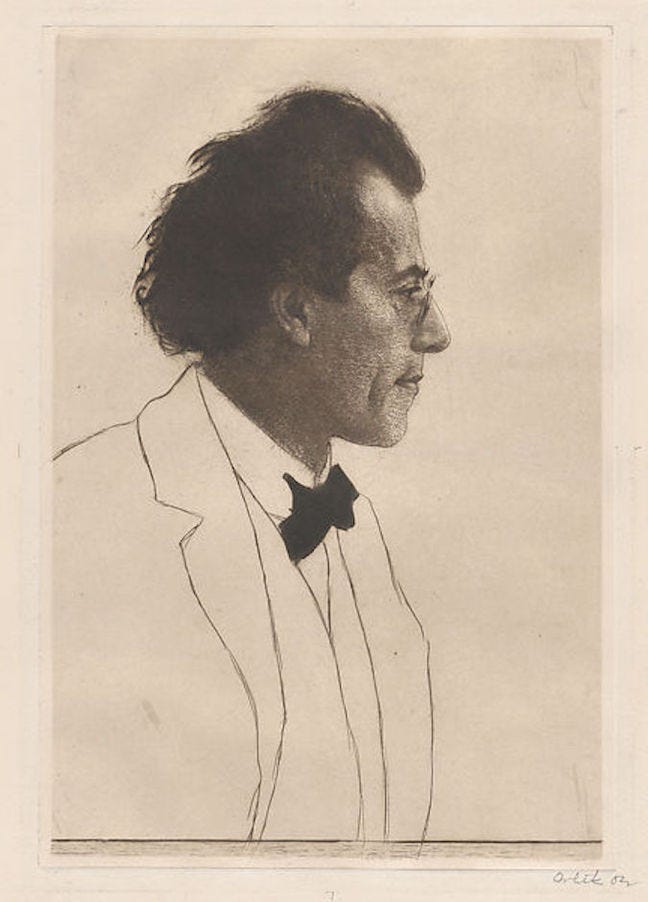
Mahler’s “Resurrection” Symphony, no. 2, was put aside, as not relevant to the Christian conception of Easter. (Someone turned to me and said, “You wrote an essay on that!” — Yes, I’ll reproduce it below.)
After going back and forth a bit, I proposed that we do not recognize Easter music because it is not set apart. Rather, in music, Easter is seen in what we expect in a “finale.” After all, why don’t more pieces peter out into nothingness at the end, like Tchaikovsky’s Sixth Symphony (or even Brahms 3)? As a rule, they end in triumph and joy.
Someone then said that if this is so, then the greater the finale, the more Easter-like it should be. What then are the very greatest finales in music? I said that surely the last movement of Beethoven’s Ninth symphony would be a contender. Or think of the finale of Mahler 1.
What one so often sees in a finale is a transfiguration and almost divinization of a theme from earlier in the piece: consider Tchaikovsky’s Fifth Symphony.
Music for Easter? (from The Catholic Thing, Tuesday, April 30, 2019)
Here’s a puzzle. Handel’s Messiah is only one-third about the birth of the Lord; the other two-thirds are about his Passion, Resurrection, Ascension, and Second Coming. Why do orchestras feature it, and crowds go to hear it, in Christmas season only, not the Easter season?
Here’s another puzzle. Why are there no works of music associated with Christ’s Resurrection, while there are many for his birth? (One might as the same for painting: why no famous masterworks depicting the Resurrection, but many scenes of the Crucifixion and Deposition?)
The musically minded among you might ask, What about the Easter Oratorio of Bach? But isn’t that the exception that proves the rule? Besides, this “oratorio” is really a cantata – a fine but not exceptional cantata – and, yes, a church composer who wrote over 300 cantatas would have written one for Easter Sunday too.
Ah, but what about Mahler’s Second Symphony, the “Resurrection Symphony”? you might ask. Isn’t that a great Easter season work? And, if it doesn’t yet enjoy the status in our culture of Handel’s Messiah, maybe it should.
Well, let’s pause and not hesitate to affirm that Mahler’s Second is one of the truly great works of classical music, a piece that seems to capture the whole human condition. Many serious musicians I know have spent a year or two of their lives completely in its grasp, listening to it constantly, enthralled with it, obsessed with it. When the BBC once asked conductors, those who should know best, to rank the greatest symphonies, Mahler’s Second was included in the top five.
But let’s be clear that this “Resurrection Symphony” is not about Christ’s Resurrection but a general resurrection, which Mahler looked for. That’s not necessarily a bad thing, so long as we are clear about it and read the “signs of the times” here in the right way.
*
Mahler wrote program notes for the symphony, which he later retracted. Great composers, like great poets, because they write from inspiration not technique, are not usually the best interpreters of their own works, as Plato pointed out long ago. But Mahler’s comments do give a good sense of the symphony’s structure at least.
It begins with a 25-minute-long movement called Todtenfeier, “death rites,” a meditation on the unavoidable reality of death. “We are standing at the coffin of a beloved person. His life, struggles, suffering, and ambition pass one last time by our spiritual eye… Why have you lived? Why have you suffered? Is all of this just a terrible joke?. . .Is all of this a wild dream, or has this life and this death a meaning?”
Thus, Mahler. He even instructed conductors to pause a full five minutes after this movement, before going on, presumably to let the fact of death sink in.
The next two movements underline the absurdity of a life ended in death. The second evokes times of lost innocence and simple happy days, with its elegant dance melody, a Ländler (think of the Captain and Maria Von Trapp dancing sweetly under the moonlight).
The third highlights the apparent meaninglessness of suffering: “If you watch a dance from a distance through a window,” Mahler commented, “without hearing the music, the gyrations of the couples seem strange and senseless because the key element, the rhythm, is lacking. That is how you must imagine someone who is destitute and unlucky: To such a person the world appears as in a concave mirror, distorted and mad.”
So, Mahler is telling us, both the joys and sorrows of this life demand a solution beyond death. He’s surely right about that. And he states the problem beautifully. Next, the fourth movement, a choral movement, gives his key to the solution, in the line: “I am from God and shall return to God!”
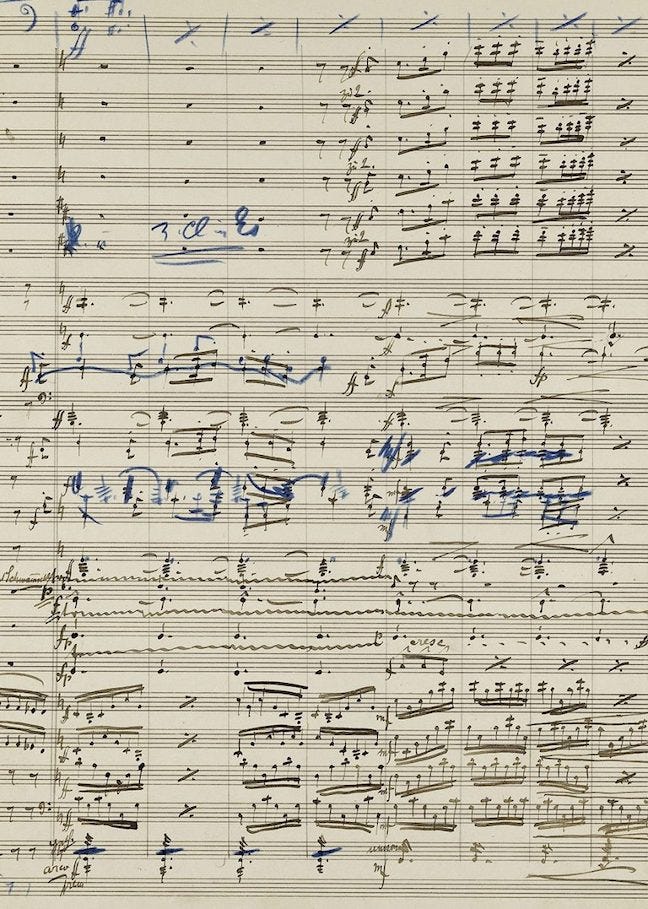
Manuscript of Mahler’s Second (one page of 232)
Yet here the Christian will want to step in and say two things, by way of warning and correction. First, we can’t get back to God on our own, since that’s a destiny which transcends our abilities – contrary to the heresy which has been called “neo-pelagianism.” Second, the mere fact of our spiritual nature does not guarantee such a return, because we are alienated from God by sin – contrary to the twin heresy of “neo-gnosticism.”
But Mahler’s choral finale presupposes both of these heresies. The libretto begins well enough, in taking lines from a resurrection poem by Friedrich Gottlieb Klopstock:
Rise again, yes, rise again, Will you My dust, After a brief rest! Immortal life! Immortal life Will He who called you, give you.
To bloom again were you sown! The Lord of the harvest goes And gathers in, like sheaves, Us together, who died.
Here our resurrection is presented, correctly, as a gift not a birthright, since of ourselves we are merely God’s “dust” (Staub). Also, it takes place under the eye of the “Lord of the harvest,” who surely will sort out wheat from weeds.
But the remaining stanzas, written by Mahler himself, go awry: “With wings which I have won for myself,/ In love’s fierce striving,/ I shall soar upwards,/ To the light which no eye has penetrated!” We even see the restrained nostalgia evoked earlier in the symphony morphing into a blurry sentimentalism: ”O believe, my heart, O believe: Nothing to you is lost!”
Is it too harsh to claim to see incipiently in Mahler the “sentimentalism which leads to the gas chambers”? But surely he assumes heresies that keep others, and maybe ourselves, from fully recognizing that we need a Savior – and therefore from truly exulting that, indeed, we have one.