
Mea Culpa
Better late than never

I apologize to my fans for not posting before the evening. I was pressing all day to finish revisions in a book manuscript. I woke up at 4 am and, except for times of prayer and attending Mass, I worked with great intensity until 4 pm. But I was unable to finish it. This was very frustrating and a cross.
I had worked a lot with Claude on the revisions. Claude is excellent with routine tasks such as placing all footnotes and the bibliography in proper form. It also is tremendously useful in mapping out work and formulating punch lists. It is a great aid in placing order in one’s work. On the other hand, it can lead one to think that such quasi-mechanical tasks are sufficient. Often a fix needs to go deeper. Sometimes a single insight solves multiple problems. And AI can occlude these things; it can prove a positive hindrance. But we learn as we go.
Today is Tuesday, and therefore I will say something about the Scripture reading for the coming Sunday.
But first, beauty from the vault, a picture of a cocktail made at Bar Termini in London, for a friend who is attending the ARC conference.
My celebrity chef friend says he considers Bar Termini the best bar in the world. He owns several himself, and his friends own most of the top ones. He should know. Apparently they pioneered sous-vide methods in cocktails and have used sous-vide to make, he says, “the best Negroni in the world.”

Now, for Scripture, I think I will say something about the NT reading and the Gospel both. Here’s St. Paul:
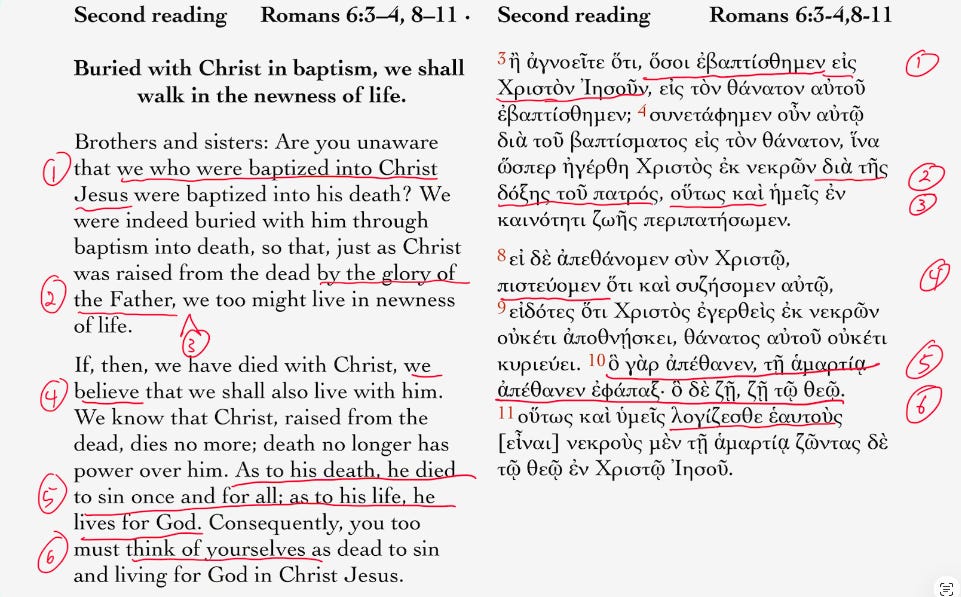
About this, I wish to say the following.
1—The NAB and most modern translations do not quite capture the sense here. It’s not “we who were baptized” but “of us human beings, those who were baptized.” I have to go to the KJV in this case to find a translation which sees what is going on and tries to render it: “Know ye not, that so many of us as were baptized into Jesus Christ were baptized into his death?” This is important. St. Paul begins from the perspective of the entire human race. He is conceiving Christians as those called and picked out from this group. (Pastors: I leave it to you to draw out the consequences.)
2— “by the glory of the Father” is really “through the agency of the glory of the Father.” I heard a good homily last Easter by my own pastor on the thought: “Christ could not but rise from the dead.” Something similar is meant here, I think.
3— The NAB’s “we too might live” is an undertranslation, as it ignores the Greek word houtōs, “so also.” This word needs to be rendered in the space I’ve marked with a caret. (And, I just noticed, "might live” is another undertranslation or mistranslation. It is rather “might walk,” that is, along a way or a path.) The Douay-Rheims is good enough here: “so we also may walk in newness of life.” But I think that St. Paul is emphasizing “we”: it means “we ourselves.” It should really be, in full, “just as Christ was raised from the dead by the working of the glory of the Father, so too we ourselves should walk in newness of life.”
4— Not “we believe” a proposition but “we have trust,” “we rely upon,” or “we venture that.”
5—The "As to his death … as to his life…” is intensely misleading. The construction refers not to two aspects of the same person and life, but to a former life, which has been put to death, in contrast with a present life, which has been raised and continues alive. The construction is technically a “cognate accusative.” NASB gets it right: “For the death that He died, He died to sin once for all time; but the life that He lives, He lives to God.”
6—NAB’s “think of yourselves” is an undertranslation. It’s not a matter of seeing oneself in a certain way or in a certain respect. It’s a matter of how one recognizes worth and value. Paul’s meaning is: reckon yourself, count yourself, in deliberations construe oneself to be. Once again the KJV renders it well: “Likewise reckon ye also yourselves to be dead indeed unto sin, but alive unto God through Jesus Christ our Lord.”
I have some things to say too about the Gospel, as I mentioned, but as it is getting late I will share them tomorrow.
Ciao!
liked the combo of ref to AI (Claude) and to Romans (close reading)