
Reporting for Duty
Varieties of ugliness, a recursive table of contents

I have a son who joined the Navy. When I dropped him off for Officer Candidate School in Newport, Rhode Island, I expected I could walk with him to his room and spend some last minutes with him as he unpacked a bit. Not so. The moment he engaged with the Navy officers at intake, he was “theirs.” The officers indicated by their attiude to me that I was to leave. They did not want to deal with me. They would deal with my son who henceforth was “in the service.”

(my son on the left, no longer a Heights student—that officer did not so much as acknowledge my existence)
Something like this transition is supposed to take place for every Catholic today, Ash Wednesday. We are reporting for a tour of duty which is to last six and a half weeks. If we do so correctly, then we ought not so much as acknowledge the existence of ourself from yesterday.
This is made clear by the “Collect” of today’s Mass. The Collect (pronounced “KAH-lect”) is the short opening prayer which brings together those in attendance and “collects” them into a single body for the purposes of worship.
I had a spiritual director once who would ask me to read and meditate upon the Collects of the Masses during a spiritual season (such as Advent or Christmastide). Unfortunately, the English translations tend to be so streamlined and simplified that the rich meaning of the Latin gets lost. Fortunately, AI can help you. You can ask it for a full, literal translation, and use that for meditation rather than what you find in the Missal. I have purchased the lifetime subscription to Universalis and use that always with side-by-side Latin for the prayers and Greek for New Testament. You can find the Latin there.
Here is today’s Collect in Latin:
Concéde nobis, Dómine,
præsídia milítiæ christiánæ sanctis inchoáre ieiúniis,
ut, contra spiritáles nequítias pugnatúri,
continéntiæ muniámur auxíliis.
The English translation in the Missal is not bad for this one:
Grant, O Lord, that we may begin with holy fasting this campaign of Christian service, so that, as we take up battle against spiritual evils, we may be armed with weapons of self-restraint.
I tend to think that inchoáre praesídia means something like “to begin our tour of duty”: and then, the holy fasts effect our reporting for duty.
Also, this translation personalizes the prayer too much, so that it becomes the prayer of an individual rather than the common prayer of a military unit. (It is a “Collect” after all.) In particular, the phrase “self-restraint” is to be avoided.
Thus, one might render to bring out the full martial character of the prayer:
Give us the gift, O Lord, of our reporting for guard duty in Christian military service, precisely through our undertaking of holy fasts, so that we, who are about to do battle against all kinds of spiritual evil, may be fortified by the supporting forces which derive from strict discipline.
The “self-restraint” is corporate self-command, that is, military discipline. Each Catholic fasts for the whole militia, not simply for himself.
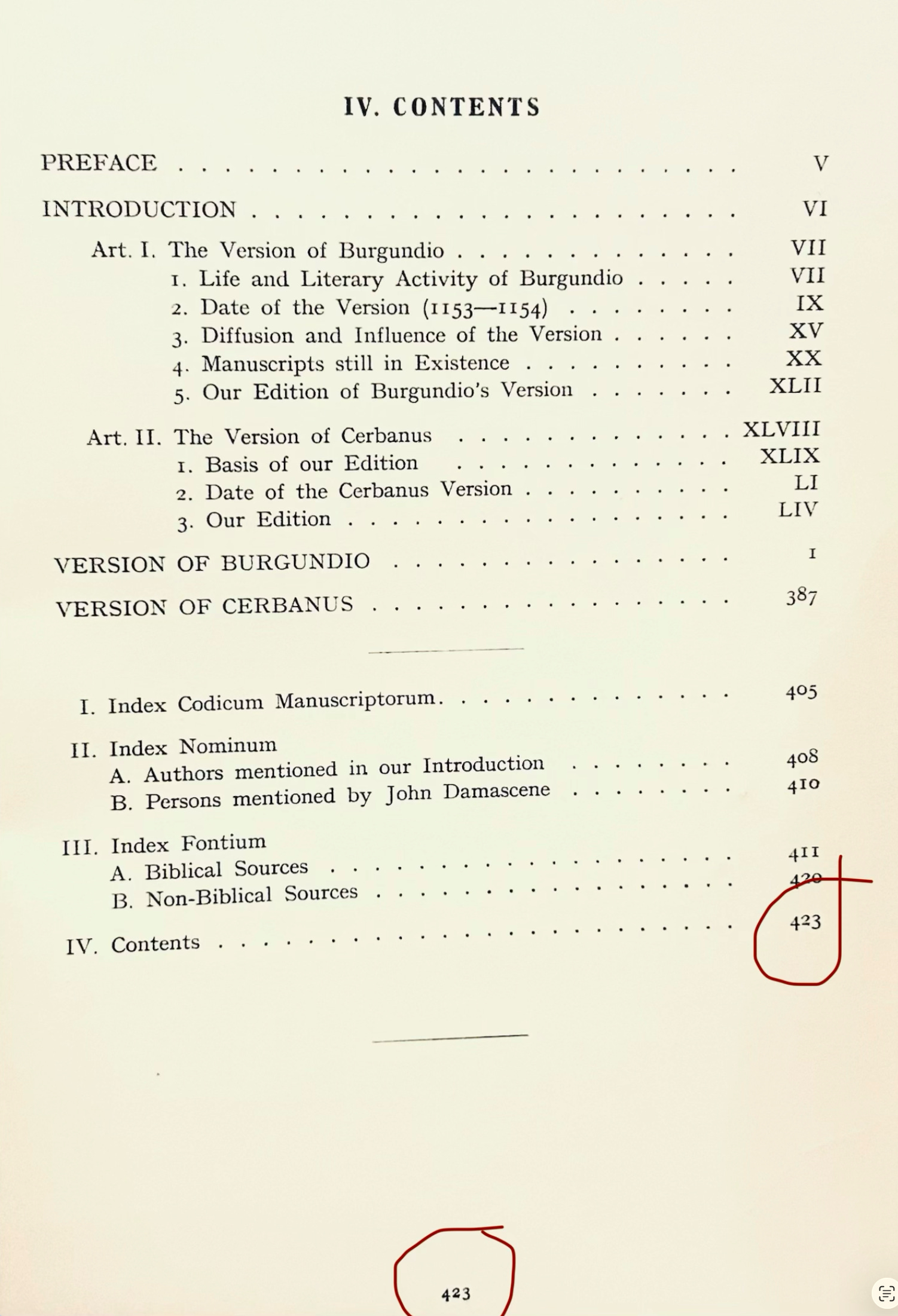
Not every text can be found in electronic form online. For instance, I had to go to my university’s library yesterday to borrow the critical edition of the Latin translation by Burgundio of St. John Damascene, De Fide Orthodoxa. Why is this translation so important to consult? Because it is the one used by St. Thomas Aquinas.
But here’s something humorous about it, a recursive Table of Contents. I don’t think I’ve ever seen that before. Needless to say, it was of no use in finding itself:
—
In my class on Catholic Social Thought (CST) yesterday, it was time I thought to introduce to the students the “four principles” to which many commentators believe CST can be reduced (sigh): dignity of the human person, common good, subsidiarity, and solidarity.
I emphasized to students that these are names of principles not principles. A principle must be a binding statement which includes words such as “should” or “should not.” Even to define “common good” would not be to state a principle.
So, I worked out along with them and offered what I regarded as good formulations of these as principles, which I give here:
1. Common good: The good of a member of an association, qua member, is subordinate to, the good of the association as a whole, and therefore the latter ought to be preferred by each member, qua member, over the former. There are three principal common goods like this:
a. The common good of the universe: God
b. The common good of humanity: peace, friendship
c. The common good of political society – the robustness of conditions and possibilities of flourishing of society as a whole and all its elements, including institutions which respect individual freedoms and rights (such as the right to religious liberty and the natural right to private property)
2. Solidarity: For each association in which I am a member, whether voluntary or not, I should, to the appropriate degree and in the appropriate way, regard and treat the other members as “other selves.”
3. Subsidiarity: In a an organic association, with a hierarchy constituted in part by nature and in part by convention, and with differentiation, each subsidiary association should be tasked with the role that is appropriate to it; in particular, tasks, as a rule, should be carried out by the lowest level association competent to carry them out; and a higher level association should intervene in the activity of a lower only in cases of gross failure, and only in such a way as eventually to see to the restoration of the good function of that lower level, not to subvert or permanently replace it.
4. Dignity of the human person: The human person in imago Dei has an eternal destiny, and transcendent life and powers, and therefore is to be loved both because of these, and because he is like God and dear to God. The human person’s nature, subjectivity, and destiny, are to be acknowledged in all human activities.
—
Over a commercial during the Olympics I said to my 16 year old son in the presence of my 9 year old son that the commercial (for the new Frankenstein movie) was “grotesque.” The 9 year old asked, “what does ‘grotesque’ mean?” Good question. How to explain it? I said, “ugly, but in an exaggerated, distorted, and disordered way, and gratuitously so.” (Apparently he knows what ‘gratuituous’ means.) During another commercial: “That was crass.” The 9 year old: “What does ‘crass’ means?” Another guess: “Ugly but in a low way, appealing to low tastes, and also unnecessary.”
T.V. commercials: varieties of ugliness.