
Sacrifice: II
Ineffable advocacy

Yesterday I defined sacrifice as the final, irrevocable, fitting, acceptable, and free offering up to a deity of something valuable to us, through its destruction, with a devout purpose.
I developed that definition conceptually, but as I was formulating it, I was struck by how it seemed to echo words from the First Canon of the Mass:
Quam oblatiónem tu, Deus, in ómnibus, Qæsumus, benedíctam, adscríptam, ratam, rationábilem, acceptabilémque fácere dignéris: ut nobis Corpus, et Sanguis fiat dilectíssimi Fílii tui Dómini nostri Jesu Christi.
Be pleased, O God, we pray,
to bless, acknowledge,
and approve this offering in every respect;
make it spiritual and acceptable,
so that it may become for us
the Body and Blood of your most beloved Son,
our Lord Jesus Christ.
Its “becoming so,” in what is called transubstantiation, would imply its being destroyed. The substances of the bread and wine are destroyed and replaced by the substances of the body, blood, soul, and divinity of Christ. That is why the Lutheran doctrine of consubstantiation eliminates the sacrifice: that which is offered is not destroyed.
This definition is a definition of the “core” meaning of sacrifice. It is also a “focal meaning.” What is the difference? A focal meaning gives the central, purest case, which works as a standard against which other cases are measured, and serves as the basis for the extension of the application of a term to other cases, through analogy and other relationships. A focal meaning, then, is to be contrasted with an analogous or secondary meaning.
A core meaning, on the other hand, gives only that which is strictly required in a thing for a thing of that kind to exist, to which may be attached necessary but external consequences, which depend on that first meaning. A core meaning is to be contrasted with a fuller or filled-out meaning.
Conceive of a focal meaning as an object encircled with various reflections or images of it. Conceive of a core meaning as a picture which has, and needs, a frame.
For example, if I define happiness as “activity of life in accordance with virtue over a complete life,” and someone says “happiness is playing golf,” then the first use of “happiness” stands to the second as a focal meaning does to an analogous meaning: the happiness of playing golf is a faint image of a happy life.
But if I define happiness in the same way, but then add, “with the moderate amount of health and material goods needed to act effectively and well,” then the first stands to the second as core meaning to filled-out meaning. Health and material goods are constituents of happiness only through their dependence upon virtuous activity.
When I say that “I am making this sacrifice for a friend,” I am using “sacrifice” in an analogous way. But “sacrifice” also has a fuller meaning. Let me explain.
If you think carefully about the core meaning of sacrifice, you see that it leads naturally to three other ideas or themes, which are seen generally in cultures in which sacrifice is practiced. These may be called: the efficacy of substitution; the primacy of the interior; and the divine power of assumption.
By the efficacy of substitution, I mean that, in certain circumstances and if done in the right way, one victim may be replaced by another victim, without changing the sacrifice—because the second is taken somehow to stand for the first. For instance, many cultures which originally practiced human sacrifice changed over time, so that a large animal came to be sacrificed instead of a human being, and yet that large animal was taken, still, to stand for or substitute in place of a human being. Thus the sacrifice was understood to be as efficacious as if a human being were sacrificed. The sacrifice did not change with the substitution.
If you think about it, the principle of the efficacy of substitution seems to follow naturally from the stipulation, in the core definition, that a sacrifice be fitting. That it be fitting means that it stands well for something. To stand for something is to point to that thing, by substituting for it. Blood stands for life; the pouring out of blood stands for the rendering of life for life. The logic of substitution is already implicit in a sacrifice.
One sees the principle very clearly at work in the Eucharistic sacrifice. The bread stands for the body; the wine stands for the blood; their separation stands for death. But also, then: Christ stands for us. His sacrifice is as efficaciously effected on our behalf as if we ourselves had been sacrificed.
The principle of the primacy of the interior follows from the facts that the sacrificial victim must be of great value to us, and that the deity does not actually take possession of the victim: the sacrificed ox is not somehow transferred to a deity’s barn. Thus, clearly, what is crucial to the sacrifice is something interior to the person who is offering it.
One might say: the worth of the gift is reflected in the preferences of the giver, not in its benefit to the recipient. And this is just as in a genuine friendship (as Aristotle pointed out long ago). In a genuine friendship, what is exchanged is not an equality of the benefits received, but rather an equality in the sacrifices made. This idea is very clearly depicted by the O. Henry short story, “The Gift of the Magi.” The husband sells his prized watch in order to give his wife a lovely comb for her hair. The wife sells her hair in order to buy a chain for her husband’s prized watch. Each gift ends up being completely useless. Neither has any benefit to the recipient. Yet their exchange was perfect, because it was equal: each gave up his most precious possession.
In the Jewish tradition:
16 For thou hast no delight in sacrifice;
were I to give a burnt offering, thou wouldst not be pleased.
17 The sacrifice acceptable to God is a broken spirit;
a broken and contrite heart, O God, thou wilt not despise.Psalm 51
The third accrescence to the core meaning is the principle of the divine power of assumption.
Remember the famous maxim of the Schoolmen, derived from Boethius: that which is received is received in the manner of the recipient, not in the manner of the thing received? If we apply this principle to a sacrifice, then, given that the sacrifice is received by a deity, even though it is material, there must be some immaterial mode by which it is taken up by the deity. In pagan sacrifices, this mode is represented by the flames of fire reaching up to heaven, and smoke and incense rising up to heaven. Perhaps these stand for intermediaries between the gods and men —Plato calls them daimones. We call them angels. Again, the First Eucharistic Prayer says:
In humble prayer we ask you, almighty God:
command that these gifts be borne
by the hands of your holy Angel
to your altar on high
in the sight of your divine majesty,
so that all of us, who through this participation at the altar
receive the most holy Body and Blood of your Son, may be filled with every grace and heavenly blessing.
Note the language: God must command that the gifts be brought to him. We cannot, through our efforts, effect the assumption of these gifts.
What I am calling the principle of the assumption, by the deity, of the offering, implies a suspicion of, or at least openness to, the conception of the deity as being all-knowing and all-powerful. If Apollo can see and take up an offering to him at his shrine, what keeps him from seeing and taking up an offering to him anywhere?
Through the ascription, implicitly, of these powers to the deity, there is also a suspicion of, or at least an openness to, the conception of the deity as able to create. If the deity can take to itself something even out of an annihilation, then it can make something out of an annihilation, and thus it can make something out of nothing.
This logic is implicit even in pagan sacrifices, and it is why paganism is more receptive to Christianity than our oppressive, purely “horizontal” cultures.
The principle of substitution: “Christ loved me and gave himself up for me.”
The principle of the primacy of interiority: “Into your hands, Father, I commend my spirit.”
The principle of the assumption by the deity: “This is my beloved Son, in whom I am well pleased.”
For this Sunday’s scripture, I’d like to comment briefly on the reading from Paul’s letter to the Romans, which is very interesting.
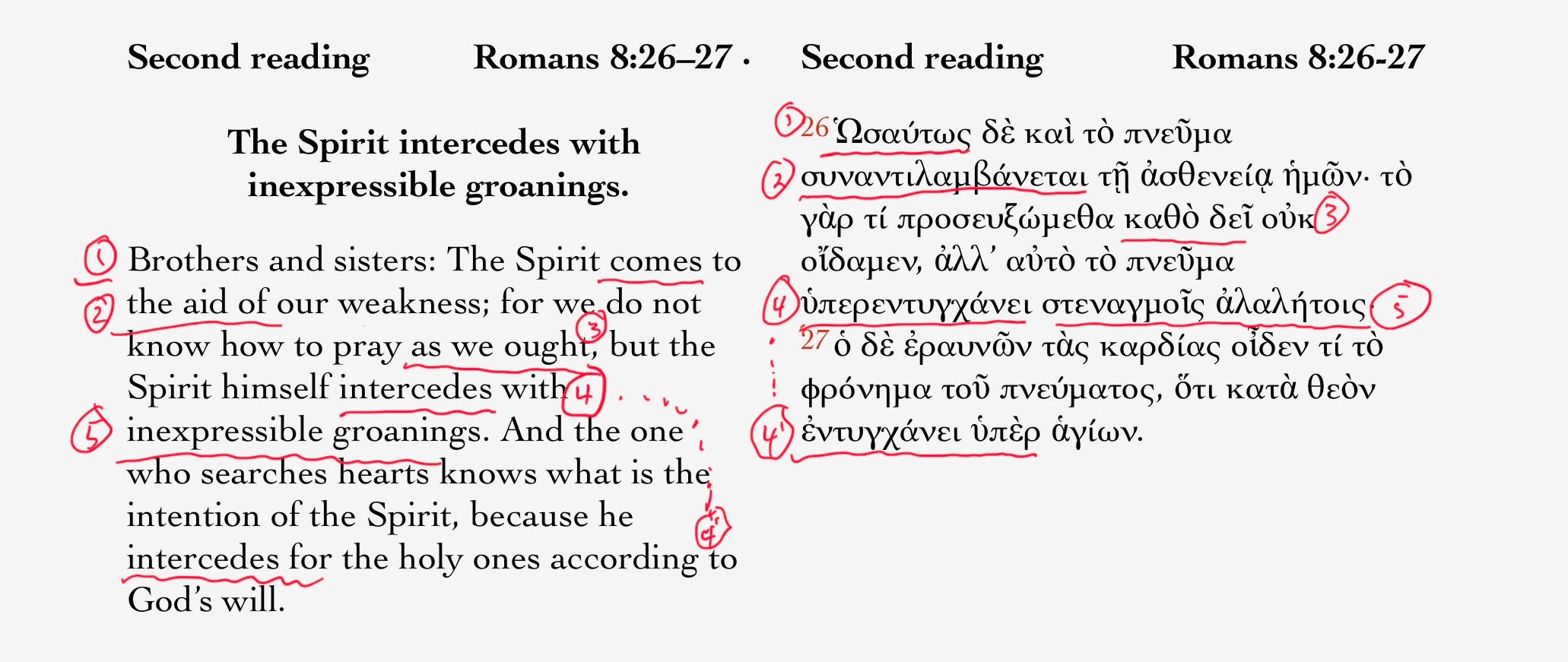
1—The Greek begins with “likewise also,” not “Brothers and sisters.” Odd! This verse introduces an additional point, to what was said earlier, in v. 23: “And not only the creation, but we ourselves, who have the first fruits of the Spirit, groan inwardly as we wait for adoption as sons, the redemption of our bodies.” This passage will speak of the Spirit’s groaning.
2—It is important for the English translation to capture everything contained in this interesting compound verb, sunantilambanetai. “Comes to the aid of” is far too weak. Imagine you are trying to move a heavy table on your own. Someone sees you and wants to cooperate (sun) by picking up (lambanetai) the other end of the table, correspondingly (anti). This is what is said. So, in English, it should be, “helps by lifting the rest of what we cannot bear,” or something like that.
3— “pray as we ought” is too legalistic; it suggests someone afraid of praying in the wrong way. What the Greek suggests (katho dei) is something like: as the thing requires. The KJV is perhaps better with its “we know not what we should pray for as we ought.” Minor point: this rendering also captures well the force of the article to at the start of the sentence.
4—“intercedes” is again much too weak for Paul’s huperentugchanei, which means rather “comes right up to us” (tugchanei) specifically to render assistance (en) on our behalf (huper). One needs a paraphrase to draw it all out. Almost all translations render as “intercedes.” But I don’t think “intercedes” contains all that. (Likewise 4’, which differs only by “on behalf of” being separated from the verb.) I think the image Paul is conveying is that the Spirit comes and stands next to us, as if to declare that it is on our side, and, from that position, it advances our true spiritual interests. This is how an Advocate works.
5—Some Fathers, including Augustine, apparently believed that the groanings were ours, which were then interpreted by the Spirit. But Paul (I think) is clearly taking the Spirit to groan. It groans with utterances which cannot, by us, be placed in words, and yet the Searcher of Hearts can interpret them.
It’s just a stunning passage which make one really marvel at how, at the very beginning of the Church, Paul had such a complete understanding of its spiritual life.
Ciao.
The Roman Canon is THE essence of the Mass. Its core. When the Concilium conceived the Norvus Ordo Missae in the late 1960's they very tellingly eliminated it. The Mass is not acceptable to Protestants with the language of the Roman Canon for the very reasons you give here. They presented this new mass to Pope Paul VI and he told them the new mass cannot exclude the Roman Canon. The Holy Spirit was working through the Pope this way. The Concilium very cunningly decided to make the Roman Canon optional. In that way, it would still be approved but priests didn't have to say it. I am in my late 40's and although I attended Catholic schools for K-12 and went to Mass every Sunday with my family, I never once heard the Roman Canon. I remember when I heard it for the first time. It captured my attention and I wondered who all those people were that it named. This is one of the indicators of a reverent Mass now. Does the priest giver preference to the Roman Canon? That is how the GIRM is written. The Roman Canon should be the default, the preferred "Eucharistic Prayer". But most often it is not. This is adversely affecting our faith. Lex orandi, lex credendi.