
Small Big Point
Austin virtutes

The strengths of Austin, Texas, —Austin’s virtutes or “powers”—are on display as I visit the city today to give a talk on what is bound up in our culture’s relatively recent abandonment of talk of “the passions” in favor of talk of “emotions.” The talk falls nicely into three sections. I’ll post these successively over the next three days.
For today, “beauty from the vault” is a light lunch of puerco con queso, with lots of green chili salsa, and a local amber beer in an Austin bar. It’s not so much from the vault as from inventory by what accountant’s call LIFO:

As today is Tuesday, I will comment on the gospel reading from the coming Sunday, which is the following:
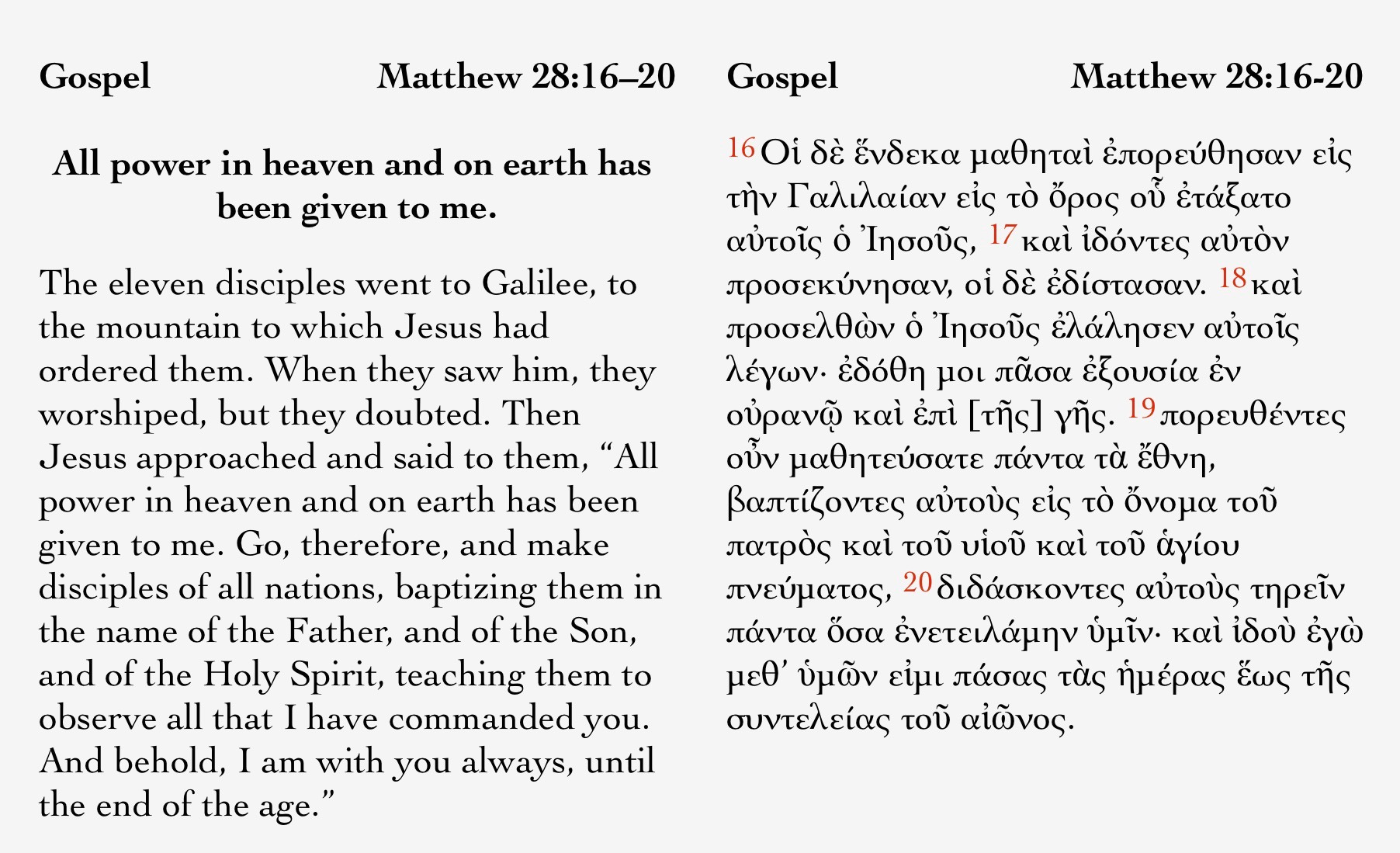
It’s the Great Commission, which I commented on recently. But I will make just two points today. One point is for those who don’t have any Greek, and the other is for those who do, or who don’t mind trying to follow along with something that may be a little challenging. I will aim to explain this second point as best I can.
The first point involves authority in the Church. Notice that the Apostles are introduced here as “the eleven disciples.” Judas, of course, is no longer with them. But they retain their structure. They never were “the disciples who just happened to number twelve.” They always were “The Twelve.” And we know that, soon, they themselves will attest to this structure, by select a replacement for Judas by lot.
N.B. The selection by lot is itself significant, because it gives greater weight to the office that is filled, than to the man who happens to be chosen to fill it. The offices do not “happen to be twelve,” but there is a real sense in which the men who filled them “happened” to fill them. (Yes, they filled them by vocation, but a vocation is a free gift to the person called.)
But this is not yet my point. My point is that immediately after Jesus says that “all authority” has been given to him, he shares this authority with this “structure,” with these eleven: “Go … and teach them to observe all that I have commanded you.” That is, the disciples are to teach with this conferred authority.
What do they teach? “All that I have commanded you.” What is that? It was and could only be: what these disciples said it was. They had full authority to conceive, systematize, express, condense, abbreviate, translate—in order to teach—“all that I have commanded you.” It was left up to them.
Nothing was written down then. There were no gospels or epistles. It would be twenty or thirty years — a whole generation would pass—before anyone would write anything down.
And then, when something finally did get written down — would the writing judge the Twelve, or the Twelve the writing? Wouldn’t the Twelve say whether what had been written down served as an apt tool, or not, for conveying what had been commanded them? They did not lose their authority just because someone wrote something down.
Obviously, if you were one of the Twelve, one important teaching which had been commanded you, and which you would find it important to convey, would be that you had been given an authority to teach—prior to anything written—conferred directly upon you by the Lord.
But this is what this verse says.
No wonder the Apostles approved Matthew’s little work for use in the Church.
Second, I wish to say something about the Greek of this text. When the NAB in v. 16 has “the disciples went to Galilee,” it is a bit of an under-translation, because the Greek verb (poreuomai) has the sense, the connotation, of going out of, leaving, departing from. It’s not that they “went to Galilee.” That’s actually absurd. Galilee was nowhere compared with Jerusalem. It’s rather that they “traveled out to Galilee.” It’s like, if you’re in New York City, it’s not that you “go to Westchester,” it’s rather that you “leave for Westchester.”
But the same holds for the second occurrence of the verb in verse 16 of this passage, where the verb is in the imperative mood. “Go and make disciples of all the nations” is really: “LEAVE THIS PLACE. GO OUT FROM IT.”
And here’s an interesting tiny little textual detail. The better texts do not unreservedly support the word “therefore” (Greek, oun) in verse 19. That word may actually have been omitted and added by a scribe. Or, the alternative I prefer, is that the word may originally have been “now” (Greek, nun), and ‘corrected’ in some manuscripts to read “therefore.” (It’s easy to confuse nun with oun.)
What I think Jesus said was “Leave now.” Don’t hang around here. Don’t dilly-dally. Don’t stay attached to your familiar lands and home. Leave without delay.
Yes, perhaps the scribes and certainly textual critics have felt the need for some kind of inferential word here. “All authority has been given to me”—hence, therefore, it follows that you should—“Leave now.”
But this verb for leaving can carry with it inferential force implicitly. “Neither do I condemn you. Leave and sin no more.” No inferential particle; but the inference is clear. “Who was neighbor to that man? You go and do likewise.” No inferential particle, but the inferential force is clear.
“All authority has been given to me. Leave now.” It follows.
FYI. Here is my latest working proofreading prompt, which has been amended after Claude missed something egregious. I will place the newly added clause in boldface:
“Proofread this as a copy editor would, reading against the possibility that every sentence contains an error. Flag: (1) typos and spelling errors; (2) grammatical errors; (3) drafting residues — words or phrases that appear to be notes to the author rather than finished prose; (4) incomplete thoughts; (5) punctuation errors; (6) inconsistencies of register or tone; (7) semantic errors — words or phrases that are individually recognizable but together fail to produce idiomatic or coherent sense, including near-miss idioms, garbled collocations, and plausible-looking but meaningless constructions. List every item you find before offering any stylistic observations.”
As I said, I expect this list to become articulated in the manner of legal writing.
Ciao!
This fascinates me, Michael. And it raises a question about the translation of Matthew 19:24 that I don't recall you addressing in BE GOOD BANKERS. The Lord says, "Again I say to you, it is easier for a camel to pass through the eye of a needle than for one who is rich to enter the kingdom of God." I read somewhere that in both Hebrew and Aramaic the words for "camel" and "rope" are similar. If so, wouldn't it make sense that Jesus would have said to his Galilean listeners that it's "easier for a rope to pass through the eye of a needle . . ." The image of a fisherman trying to shove a nautical rope into a needle would, it seems to me, have been funnier and more immediate than the odd (albeit arresting) image of a camel squeezing through. (I understand there were entrance gates to some ancient cities called Needle's Eyes, guarded but left open at night for late entry, that all but necessitated a camel to stoop down to its knees, thus to slow the entry for security purposes.) I first read about this in an interview Anthony Burgess gave about his contribution to the teleplay for Zeffirelli's "Jesus of Nazareth." -Brad