
We Hear What We Know
Alternatives to end times hysteria

Allen Guelzo on Golden Thread today has a fascinating post, “The State of the Lincoln Art,” which closes by identifying some still open areas of investigation into Lincoln:
Lincoln’s intellectual sources: Lincoln read far more widely and deeply than even his contemporaries gave him credit. But what he read, and how he used it, are questions that still contain many regions of mystery. Robert Bray’s Reading with Lincoln (2010) is a non-negotiable starting point for Lincoln’s literary curiosity. What still awaits us is a serious reckoning with his reading in his favorite subject, the political economy of the 19th century, in which Shelby Cullom once said that Lincoln’s standing was “great.” Yet, we have had no hands-down successor to the late Gabor Boritt’s Lincoln and the Economics of the American Dream in 1978. (The closest competitor may be Richardson’s Greatest Nation of the Earth). We should also be more aware of Lincoln the borrower. For instance: his famous invocation of America as the “last, best hope of earth” was almost certainly lifted, and without attribution, from Andrew Stewart’s fervent anti-Mexican War speech of February, 1847 (and perhaps even earlier, from a letter of Thomas Jefferson to Ceasar Rodney).² And what did Lincoln mean when he told Noah Brooks that the most influential books he had read were John Stuart Mill’s On Liberty and Bishop Joseph Butler’s Analogy of Religion?³ I suspect that Brooks mis-heard Lincoln about Mill (since On Liberty was only published in 1859) and that what Lincoln meant was Mill’s 1848 Principles of Political Economy (from which he more-or-less filched an entire paragraph in his 1859 Wisconsin agricultural fair speech). But Joseph Butler?
If it’s true that Brooks heard what he knew, not what he didn’t know, and he knew Mill’s On Liberty, a very popular book, but not the Political Economy, then it’s probably also true that he heard The Analogy because he knew it and had studied it (it was one of the most widely-assigned readings in college in the early 19th century), but he couldn’t hear Rolls Chapel Sermons, because he hadn’t read those.
But the Rolls Sermons would be an obvious source for Lincoln’s view about the centrality of self-love, as in this famous story told by William Herndon:
Mr. Lincoln once remarked to a fellow-passenger on an old-time mud-coach that all men were prompted by selfishness in doing good. His fellow-passenger was antagonizing this position when they were passing over a corduroy bridge that spanned a slough. As they crossed this bridge they espied an old razorbacked sow on the bank making a terrible noise because her pigs had got into the slough and were in danger of drowning. As the old coach began to climb the hill, Mr. Lincoln called out, 'Driver, can't you stop just a moment?' Then Mr. Lincoln jumped out, ran back and lifted the little pigs out of the mud and water and placed them on the bank. When he returned, his companion remarked: 'Now Abe, where does selfishness come in on this little episode?' 'Why bless your soul, Ed, that was the very essence of selfishness. I should have had no peace of mind all day had I gone on and left that suffering old sow worrying over those pigs.'
(The Rolls Sermons are where Butler develops his account of self-love as the organizing principle of a well-ordered character. Lincoln’s study of them would explain also why he was so keen on understanding the motives of others in a conflict and his famous sentiment, “Do I not destroy my enemies when I make friends of them?")
What still awaits us is a serious reckoning with his reading in his favorite subject, the political economy of the 19th century, in which Shelby Cullom once said that Lincoln’s standing was “great.”
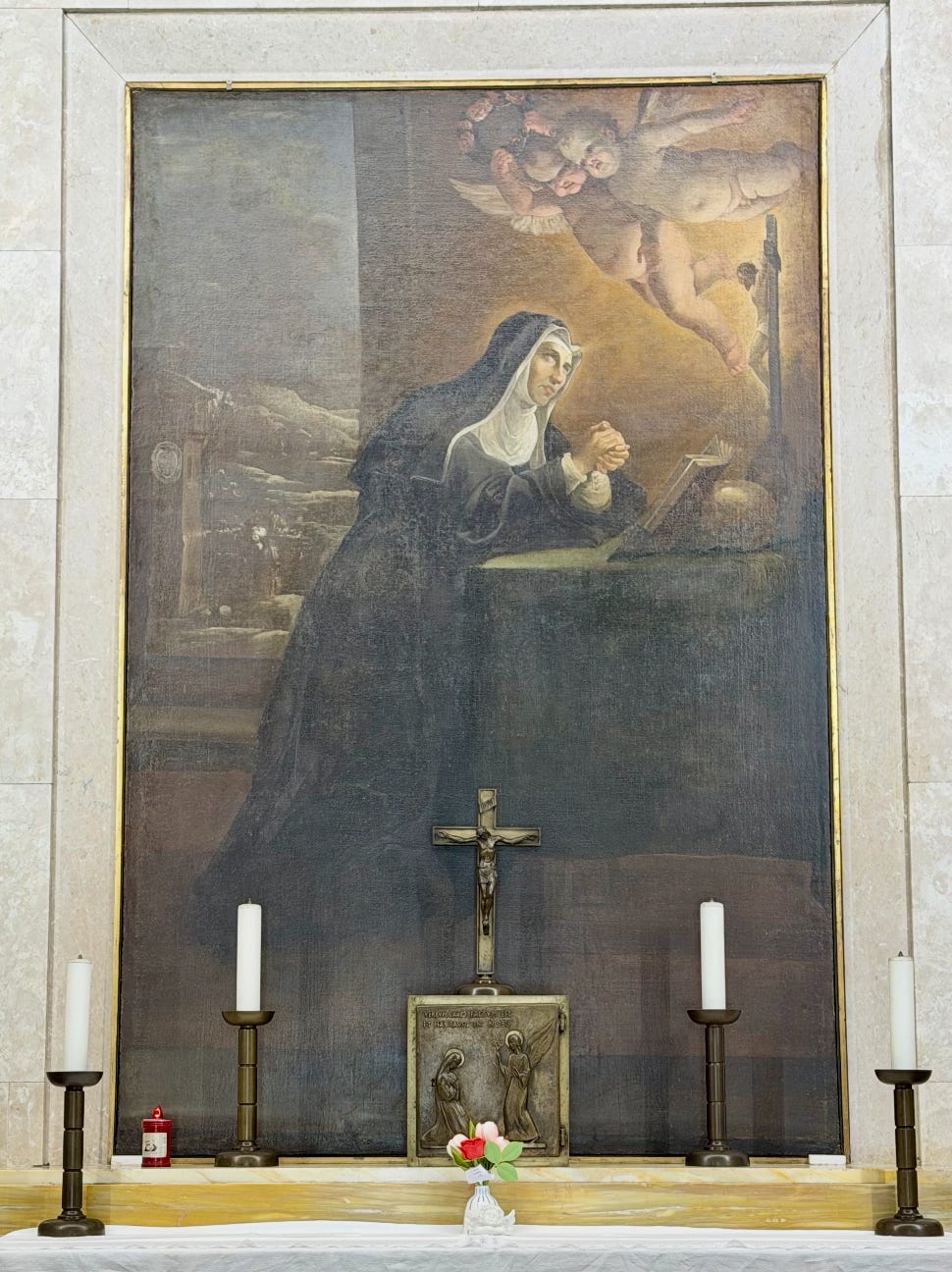
I’ve been reading a life of St. Rita of Cascia by Msgr. Richard Connolly, several chapters of which begin with terrible descriptions of her early-15th-c, world. St. Rita reacts to this world with contemptus mundi. She wants to leave it. This is a reasonable response. My question is: what other responses are reasonable?
All Rita’s thoughts and all her affections were centred in heaven, and the reason why she desired to lead a more perfect life in the cloister was thereby to make more certain of attaining the object of her desires. But the world in that century of wickedness was engaged about far different things; the vortex of worldly hopes and ambitions had engulfed almost all the aspirations of men. In the East, rapine, vice, violence, murder, irreligion, and a long train of irreparable wrongs, had followed quickly upon the victories of Sultan Bajazet and the defeats of the Emperor Emmanuel. The prolonged war was still being waged in the German Empire between Sigismund and the rebellious Hussites, who despised human life in their endeavours to spread their heresy and profane and overthrow the altar.
The government of the Church, then under Pope John XXIII., was most violently harassed by the anti-Pope Pietro di Luna, whose contumacy the Council of Constance failed to break down, as the Council of Pisa had failed before. Italy continued to be the laughing-stock of tyrants and of the resuscitated factions of the Guelphs and the Ghibellines. Of the two Visconti who governed the Cisalpine province, one was the slave of his vices and the other was the prisoner of his rebellious subject Facino Cane, tyrant of Alexandria, who was the formidable chief of a marauding band and the despoiler of the province. The tyrannous usurpations of Ottobono in Parma, Da Vignate in Lodi, Fondolo in Cremona, and Malatesta in Brescia still continued. The Romagna and the Marshes enjoyed no higher degree of liberty or prosperity under the yoke of despotism. The factions of Durozzo and of Anjou still disputed possession of the kingdom of Naples, and the ambitious Ladislaus, with designs on the whole Italian peninsula, began to threaten Rome with the fugitive Pontiff. The republics of Venice, Genoa, Florence, and Siena were either plotting against one another or actually at war. Cascia was the only one of the republics that had begun to taste the almost forgotten fruits of peace. But neither in Cascia nor elsewhere were good morals to be found; they seemed to have barely secured a refuge in the cloisters. Hence Rita was sighing night and day for the sacred shelter, and although she had till then bloomed as a stainless lily among thorns, yet she did not consider that she could live secure in the danger-laden atmosphere that surrounded her.
If you have not felt the strong wish to leave this world, you may need to contemplate actual evils more closely.
I picture soldiers of the Einsatzgruppen walking down a line shooting women and children one-by-one as they fall into an unmarked grave.
As I said, St. Rita’s response is completely reasonable. What others are reasonable? I can tell you some that are not.
Robert Nozick wrote that after the Holocaust, he stopped caring whether the human race continued to exist or not. Talk about misanthropy! I guess he wouldn’t be buying SPCX. His view got attention because he argued that the Holocaust was an evil which uniquely merited such a response. But if you’re a mom, your child’s murder counts, even if it’s just one child and it’s not a deliberate action of a corrupt state.
His response is not reasonable.
We see other responses among “conservatives” today. First, there is hysteria about cataclysms and the end of the world. This is unreasonable. Look at the catalogue Fr. Connolly gives. Horrible evils have always existed.
Second, there is pining for supposed golden days. Things didn’t used to be this way. How have we (or governments, or the elites) allowed things to get so bad? We can restore the world to the way it was.
This Golden Age utopianism is also unreasonable.
Needless to say building space ships to escape by traveling to Mars is also unreasonable.
On the other hand, living “in the world but not of the world” by hoping in heaven is not unreasonable
.
(Painting of St. Rita receiving the partial stigmata. Shrine of St. Rita, Casa Maritale, Roccaporena, Umbria, Italy.)
Tomorrow, music.
Ciao.