
What To Do
When You Finish a Book

To finish a book requires an extreme intensity of work at the very end, similar to a sprint at the end of a mile run. Yesterday, as I told you, I woke up at 4 am and, but for praying and going to Mass, I worked without letting up until 4 pm. Meals were taken at my desk.
Today, I woke up even earlier, at 3 am. This may sound absurd. But when a project is gripping me, the difficulty is even to fall asleep at all. I am eager to wake up and resume work on it.
Again, I worked (except for spiritual necessities) until 3 pm. Twelve hours just about of intense work in a row.
But—and this is the key thing—but, I finished the book. It is done. Deo gratias.
After I sent the manuscript to the press, I played 9 holes of golf with my 9-year-old, Finnan. Once again, he beat me. It seems unlikely I’ll ever beat him again. He’s very good.
Then, in the evening, a friend came over for drinks and dinner. This is a young man, an accomplished organist and highly skilled church musician, whom I met when visiting a campus through the Thomistic Institute.
I found out he liked martinis best among cocktails. I’m writing a book on martinis. Do you have a kind of martini that you like, or would you like me to make you a “classic” martini?
A classic martini, he said. After much consultation and study, this is what I have settled on:
5 parts No. 3 Gin;
1 part dry vermouth (Dolin best); and
a lemon peel.
No. 3 and 47 Monkeys are the best gins for martinis, I think. Of the two, No. 3 is best.
That’s it. Highly important: everything must be very, very, very cold. Ice cold.
Sometimes I’ve added two dashes of orange bitters and a pinch of salt. The first adds sweetness to the sharpness and astringency of the gin. The latter enchances all flavors. But this time my goal was a pure and clean, “classic” profile.
My friend loved it.
My problem is that I like it so much that I can drink it too fast, and a martini is a potent drink.
As my head was spinning, I told my friend about Dorothy Parker’s ditty, which he had not heard of. I told him that all books on martinis must include it.
After dinner, we went to the living room and listened to music. This is just about my favorite thing to do, but it’s not often that I have time for it.
What did we listen to?
He had seen a signed, framed print by the Santa Fe photographer, William Clift, hanging on the walk in our kitchen, under the rack for glasses.
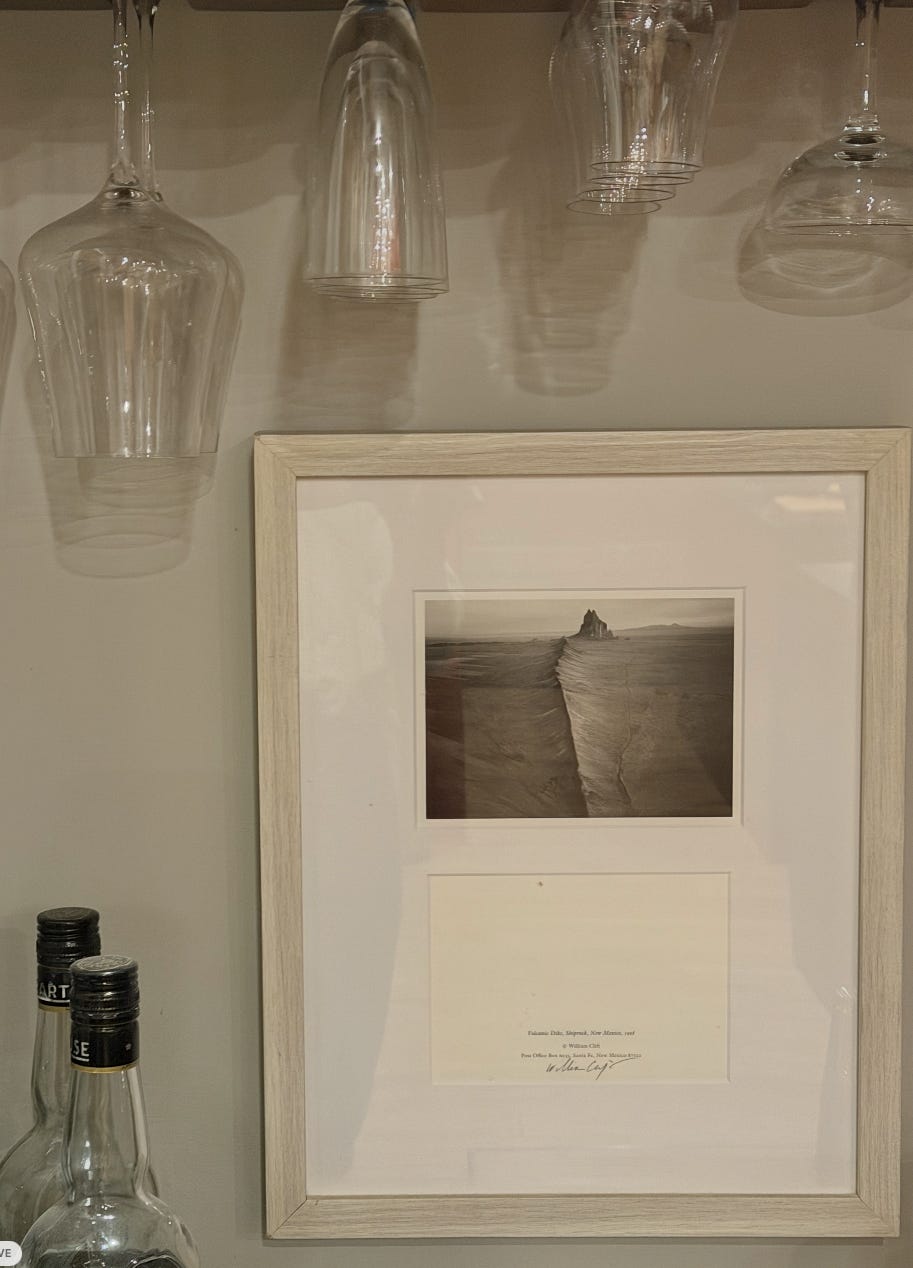
Did I know that the same photograph is on one of his favorite albums, Silencio, by Gidon Kremer?
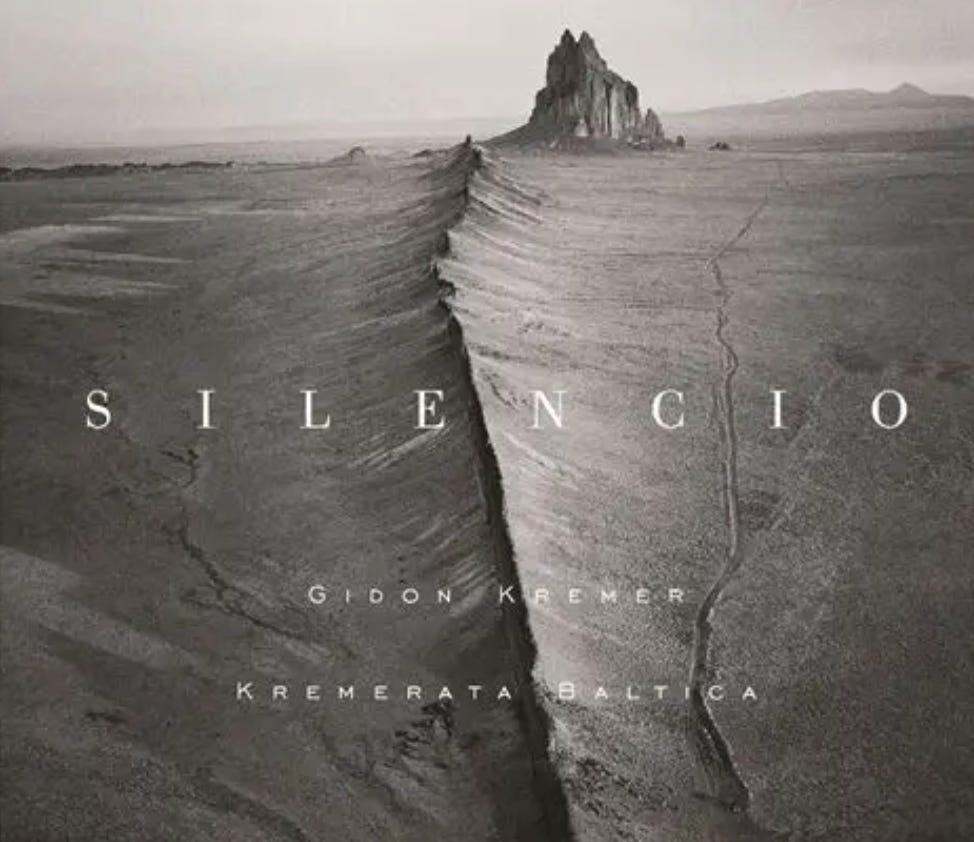
No, and I had never heard of Gidon Kremer. We listened to Kremer playing Arvo Pärt, Tabula Rasa. I.Ludus.
He told me that his favorite album of Kremer was him playing with Martha Argerich, a Shostakovich trio.
“You mean the E minor trio?”
“I don’t know,” he said, “It has the Tchaikovsky trio on the other side.”
“I love the Tchaikovsky trio! I went through a phase when I listened to every recording of it, and I kept coming back to the Heifetz, Piatagorsky, Rubinstein recording. I love that recording so much, that I hunted it down in vinyl.”
So that’s what we did. We put the LP on the turntable and listened to the first movement. He did not know this recording and was just about convinced that it was better than Kremer-Argerich.
“But what else are you listening to?” I asked. He gave three things, and we listened to them all.
“Well, Bishop Varden is giving talks which he introduces with Gracie Adams singing ‘Camden,’” he said, “I like this quite a lot.”
“And,” he next said, “have you heard the latest Mumford and Sons album? ‘Conversations with My Son’ is brilliant.”
But he is a church musician and of course he had it in mind to share a group which sings chant and polyphony. He didn’t know much about them, he said, but he’s been listening all the time to a group called Schola Hungarica.
“Listen to this track,” he said:
But what about me? What was I eager to share?
At some point our discussion turned to the question of what the best setting was of the Stabat Mater. I said I found Palestrina far superior to Pergolesi. Did he know it? Astonishingly, he didn’t! “Then you must listen to it immediately.” I told him that my favorite recording for a long time had been John Rutter and the Cambridge Singers. But, I said, once a music professor and I listened to dozens of recordings, and we concluded that the Gabrieli Consort’s was the best (all men, lower setting, slower tempo):
It was getting late—and, remember, I had woken up at 3 am—so I didn’t want to press it and play too many other things. Besides, his tastes ran to polyphony, and he would be hardly eager to hear a movement, say, from a Nielsen symphony, a recent love of mine. So I picked something short.
“I find fascinating what old stalwarts of orchestras say about who the best conductors were. For instance, I once heard an interview with Adolf Herseth. Do you know who he is?” “No.” “He was for something like 70 years the principal trumpet of Chicago. He’s universally recognized as the greatest orchestral trumpet player of all time. He played under Reiner, Solti, Barenboim, Muti — all the greats. But he said that he believed Jean Martinon was the greatest. Who would have thought? Most people have never even heard of Martinon, despite his compositions. So recently I’ve been listening to all the recordings of Martinon with the Chicago Symphony. This piece struck me as exceptionally good.”
I held up the picture of the picture of Martinon on the album. “How could you not love this guy? And can you believe that it is Chicago, not Boston, excelling in French repetoire?”
That’s all for now. Remember, I woke up at 3 am.
Ciao!
I'm under the weather right now, but when I'm back, I'm making that No. 3.